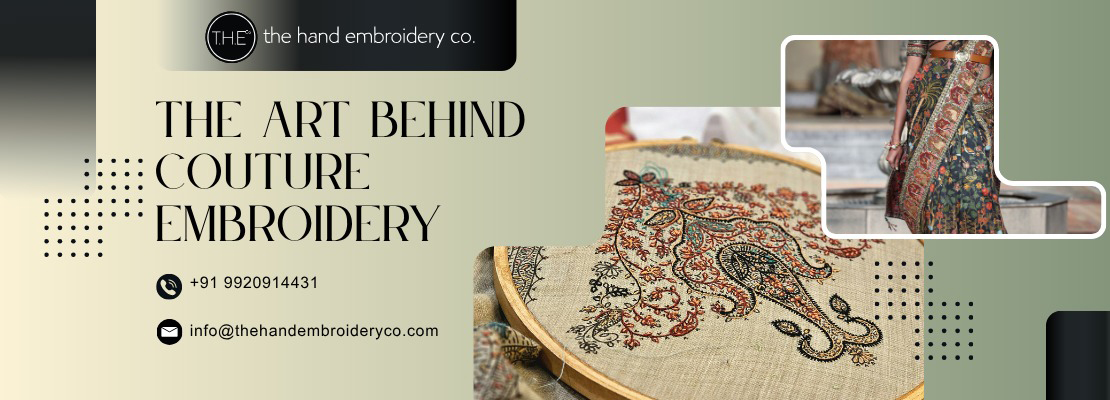
There is a moment in every great couture piece that nobody talks about.
It is not the runway reveal. It is not the media coverage. It is not even the first time a buyer holds the finished garment and feels the weight of something genuinely extraordinary.
It is the moment — somewhere in a workshop in Mumbai, at 11 in the morning, surrounded by bolts of silk and coils of metallic thread — when an artisan looks at a designer's sketch for the first time and quietly begins to understand it.
What happens between that moment and the finished couture piece is what we call "behind the scenes." Most fashion brands never see it. Most fashion audiences never know it exists. But for any designer, brand, or buyer who is serious about commissioning world-class hand embroidery, understanding this process is not optional — it is the difference between a piece that merely looks expensive and a piece that is genuinely irreplaceable.
This is the real behind-the-scenes of couture embroidery. Not the polished version. The honest one.
Why Couture Embroidery Is Different from Everything Else in Fashion
Before we go inside the process, it is worth being precise about what couture embroidery actually is — because the word "couture" is used so loosely in fashion that it has lost almost all meaning.
Couture embroidery is hand embroidery produced to the exacting standards of high fashion. It is characterised by three things that no other category of garment decoration can claim simultaneously:
First, density. A couture embroidered panel might contain 50,000 to 200,000 individual stitches. Each one placed by a human hand. Each one checked against the design. Each one contributing to a visual texture that can only be fully appreciated in person, in light, in motion.
Second, materiality. Couture embroidery uses materials — real metallic threads, hand-set crystals, cut glass, seed pearls, fine zari, pure silk floss — that behave differently on the body and in light than any synthetic approximation. The weight. The drape. The shimmer. These are not aesthetic choices. They are functional properties that change how a garment moves and how it is perceived.
Third, irreproducibility. Every piece of couture hand embroidery is unique. Not in a marketing sense — in a literal, physical sense. No two pieces of complex hand embroidery are identical. The micro-variations of human stitching, the slight individuality of thread tension, the specific behaviour of materials at the millimetre scale — these create a fingerprint that no machine can replicate and no production line can standardise.
This is why Dior flies to Mumbai. This is why Hermès has cultivated Indian atelier relationships for over two decades. This is why the most demanding creative directors in the world choose hand embroidery from India as the centrepiece of their most important collections.
Now let us go inside.
Stage One: The Design Arrives — and the Real Work Begins,
When a fashion designer or brand shares a design with a couture embroidery atelier, the conversation that follows is not a transaction. It is a translation.
The designer's sketch, mood board, or tech pack is a two-dimensional representation of something that will eventually exist in three dimensions — stretched over fabric, draped on a body, moving under light. The job of the embroidery atelier is not to copy the design. It is to interpret it: to understand what the designer is trying to achieve and to determine how embroidery can achieve it better than the designer may have imagined.
At T.H.E. Co., when a design brief arrives — whether it is a technically precise tech pack or a single reference image torn from a magazine — our response is always the same. We ask: what is this piece trying to say? What does it want to feel like? What does the designer actually need from the embroidery that the sketch does not yet express?
Sometimes the answer is obvious. A bridal lehenga brief that calls for heavy zardozi on velvet is a clear technical specification — the technique, the fabric, and the intent are all named. We move quickly to sampling.
More often, the translation is genuinely creative. A French fashion label sends a mood board referencing Mughal court architecture — interlocking geometric arches, the play of shadow on jali screens, the density of a carved marble pattern — and asks: can you make this into embroidery for silk georgette? The fabric is delicate. The reference is architectural. The translation requires both craft knowledge and creative judgment: perhaps aari-style chain stitch for the geometric lines, dabka wire for three-dimensional raised detail, and resham silk fill for the softer interior sections.
This design translation stage is where great embroidery ateliers separate themselves from suppliers who merely execute. Any workshop can follow a technical specification. Very few can contribute creatively to the design conversation while remaining entirely in service of the client's vision.
What this means if you are commissioning couture embroidery: The best brief is the most honest brief. Share what you are imagining, what you are referencing, what feeling you want the finished piece to produce. Share your fabric. Share your timeline. Then listen. The atelier that talks to you — not at you — is the one worth working with.
Related Article - Dressing Dreams: How Haute Couture Embroidery Suppliers Turn Fabric into Masterpieces

Stage Two: Pattern Making — Where Millimetres Matter,
Once the design direction is agreed, the pattern work begins.
Most people who have not been inside an embroidery atelier imagine that artisans work from the designer's sketch directly — that they look at the image and begin stitching. The reality is far more systematic, and far more demanding.
Every couture embroidery design is first broken down into a production pattern: a precise, scaled technical drawing that maps every element of the design onto the specific dimensions of the garment piece to be embroidered. The pattern accounts for the shape of the panel — whether it is a bodice front, a jacket back, a sleeve, an asymmetric panel — and ensures that the design motif scales and fits exactly as the finished garment requires.
Pattern making for complex embroidery is a specialist skill. A pattern error of two or three millimetres in a central medallion design can mean the motif does not align when garment pieces are sewn together. A miscalculation in the repeat spacing of a border pattern can mean the pattern does not complete symmetrically at the seam.
At T.H.E. Co., our in-house pattern team works from designer size charts and garment specifications to produce patterns that are production-ready before a single stitch begins. For designers who do not have a tech pack, our team creates the pattern from scratch — guided by the design reference and the garment specifications we collect during the design conversation.
The pattern is then transferred to the fabric using a process that has changed little in centuries: the design is traced onto thin paper, small perforations are made along every design line, and a coloured powder — chalk or charcoal — is pressed through the perforations to leave a faint but precise outline directly on the fabric surface. When the paper is lifted, the design is there: a ghost of the finished embroidery, waiting for the artisans.
Stage Three: The Adda — An Ancient Technology That Is Still the Best One
The embroidered fabric is stretched over a wooden frame called an adda — a long, low rectangular structure around which multiple artisans can sit and work simultaneously.
The adda is not glamorous. It is a practical tool, unchanged in its essential design for several hundred years, because it solves an engineering problem that no modern alternative has solved better: how do you keep a large piece of delicate fabric perfectly taut, accessible from multiple sides, at a working height that allows six or eight or twelve artisans to sit comfortably and stitch with precision?
The adda does all of this. The fabric is wrapped around the frame and secured with thread lacing that creates even tension across the entire surface. As the embroidery progresses, the artisans can advance the fabric on the frame — moving the stitched section off the working area and bringing fresh fabric forward — without ever disturbing the work in progress.
For a complex couture piece — a fully embroidered bridal lehenga, a heavily worked jacket back, a ceremonial garment with all-over zardozi — the adda might be occupied continuously for four, six, or eight weeks. Multiple artisans working the same frame. Each one responsible for a specific section of the design, or a specific technique within a mixed-media piece.
Watching a couture embroidery atelier at work is one of the most quietly extraordinary sights in the entire fashion supply chain. There is almost no sound. The movement is small and precise. And the fabric, slowly, becomes something else entirely.
Stage Four: The Embroidery — Technique by Technique
This is the stage that most people want to know about, and the stage that is hardest to explain without touching the work itself.
Couture embroidery at T.H.E. Co. draws on a range of Indian hand embroidery traditions, each producing a distinct visual and tactile character. Understanding these techniques is not an academic exercise — for a commissioning designer, it is the vocabulary of the design conversation.
Zardozi: The Architecture of Gold
Zardozi is the most iconic of Indian metallic embroidery traditions. The word means "gold embroidery" in Persian, and the technique — metallic threads, coiled wires, beads, and jewels worked into dense, raised patterns — has been used by Mughal courts, European couture houses, and Indian bridal designers for centuries.
The defining quality of fine zardozi is its three-dimensionality. Where machine embroidery sits flat on fabric, zardozi builds upward. Coiled dabka wires create raised ridges. Bullion knots form sculptural protrusions. Heavy metallic thread catches light from multiple angles as the garment moves. The result is embroidery that has physical presence — weight, texture, depth — not just visual pattern.
For couture fashion, zardozi is the choice for maximum impact: fully embroidered bodices, statement sleeves, dramatic ceremonial pieces. At T.H.E. Co., our zardozi artisans have been trained in the full range of sub-techniques — zari, dabka, kundan, mukaish — and can combine them in a single piece to create the layered complexity that distinguishes genuine couture from high-quality fashion embroidery.
Aari Work: Precision at Speed
The aari needle — a hooked tool that resembles a fine awl — creates an intricate chain stitch by pulling thread through from below. Aari is faster than heavy zardozi and produces a lighter, more flexible embroidery that is ideal for fashion pieces where drape and movement matter.
For a designer who wants beautiful embroidery on a flowing chiffon garment, or intricate detail on a silk blouse that needs to move freely on the body, aari is often the right technique. The precision that skilled aari artisans achieve — fine lines, tight curves, consistent stitch density across large areas — is not reproducible by any machine embroidery process currently available.
Threadwork: The Silent Luxury
Silk threadwork — resham embroidery, crewel work, fine floral hand stitching — is the quietest form of couture embroidery, and in some ways the most demanding. There is no metallic flash to draw the eye. The beauty is entirely in the precision of the stitch, the accuracy of the design translation, the quality of the silk thread.
Luxury brands that use threadwork embroidery are making a deliberate choice: they are saying that the excellence of the craft is enough, without any embellishment to advertise it. This is a different conversation from zardozi — but no less valuable to a designer whose collection relies on earned, underplayed luxury rather than visible opulence.
Mixed-Media Couture: When Techniques Combine
The most complex couture embroidery pieces combine multiple techniques in a single panel: metallic zardozi for the primary motif, aari chain stitch for the detailed fill, silk threadwork for tonal background shading, hand-set crystals or cut glass for focal embellishment points.
Mixed-media couture is where the full depth of an atelier's capabilities becomes visible. It requires artisans trained in multiple techniques, a production plan that sequences the techniques correctly (certain work must be completed before others can begin), and a quality control process that assesses the finished piece as a unified work rather than a collection of separate elements.
At T.H.E. Co., our 175+ in-house artisans include specialists in every Indian embroidery tradition we work with. This is not a subcontracting arrangement — all work is produced in our own certified workshops, by our own trained artisans, under our own quality management system.
Stage Five: The Sample Swatch — The Most Valuable Thing in Couture Sourcing
Here is the most commercially important thing we can tell any brand that is commissioning couture embroidery for the first time:
The sample swatch is not a formality. It is the most important moment in the entire relationship.
A sample swatch is a small piece of embroidery — typically the size of an A5 sheet — created using your actual design on your actual fabric. It is not an approximation. It is not a representation. It is a physical preview of exactly what the finished production will look and feel like.
What a swatch shows you that no image, video, or description can show you:
The weight of the embroidery on your specific fabric — whether it drapes as you need it to, or pulls in ways that will affect the garment's construction. The exact colour interpretation — whether the metallic thread reads as gold or copper in different lights, whether the silk thread matches your Pantone reference on this specific fabric weave. The three-dimensional texture — the height of the raised elements, the depth of the recessed fills, the way the piece catches light from oblique angles. The quality of the materials — thread lustre, bead consistency, crystal clarity, the security of every embellishment.
Great couture buyers always insist on the swatch. The brands that have been commissioning Indian embroidery the longest — the ones who have built multi-decade supplier relationships and received work that defines their most celebrated collections — never skip this step.
At T.H.E. Co., every new client relationship begins with a free sample swatch. No commercial commitment required. No invoice before we have shown you exactly what we can do. This is not a promotional gesture — it is the correct professional process, and it is how 45 years of trusted relationships are built.
A manufacturer who does not offer a proper sample process is telling you something important about how they manage quality. Listen to what they are telling you.
Stage Six: Quality Control — The Standard Nobody Talks About
When the embroidery is complete, it does not go straight to shipping.
Every finished piece at T.H.E. Co. goes through a quality control process that checks against the original approved swatch and the design specification. Our QC team examines:
Design accuracy
Does the finished embroidery match the approved design? Are all motifs correctly placed? Are borders and repeat patterns consistent?
Stitch quality
Is the stitch density consistent across the entire panel? Are there any loose threads, missed areas, or inconsistencies in tension?
Material quality
Are all beads, crystals, and embellishments secure? Is the metallic thread lustrous and undamaged? Are there any abrasions or distortions to the base fabric?
Finishing
Has all chalk marking been removed? Is the piece gently steamed where needed? Is the embroidery sitting correctly on the fabric?
Pieces that do not pass QC are returned to the workshop for correction. Not patched. Not photographed from a different angle. Corrected.
This is not a special standard for high-value orders. This is the standard for every piece, at every quantity. An order of six bridal lehengas receives the same QC rigour as a luxury hotel's 200-piece cushion order. Consistent quality across every piece in an order is not a premium offering. It is the baseline.
Stage Seven: Design Protection — The Conversation the Industry Needs to Have More Honestly
There is a question that every designer asks before sharing a design with an Indian embroidery atelier — and most of them ask it indirectly, or not at all, because they are not sure how to raise it without seeming rude.
The question is: what happens to my design once you have it?
It is a completely legitimate question, and it deserves a completely direct answer.
Your design is your intellectual property. It is also the commercial foundation of your collection — it is the thing your buyers are paying for, your editors are photographing, your brand is staking its identity on. Sharing it with a manufacturer involves real trust, and that trust must be explicitly earned, not assumed.
At T.H.E. Co., our design protection commitment is absolute: we have never copied, replicated, or shared a client's design in 45 years of operation. This is not a policy we adopted recently in response to industry pressure. It is a core value that has been the foundation of relationships with 155 clients across 12 countries — relationships that, in many cases, have lasted decades.
We formalise this commitment through Non-Disclosure Agreements for clients who prefer written documentation. We recommend sharing designs in stages — mood boards and references first, final production files after the NDA is signed. And we understand that a manufacturer's design protection promise is only as credible as their track record. Ours is 45 years. We are willing to let that speak for itself.
For any designer or brand considering couture embroidery from India: the risk is real, and the correct response to it is not avoidance — it is due diligence. Ask directly. Request documentation. Choose manufacturers with a verifiable long-term track record and a public, documented commitment to design confidentiality.
Related Article - 10 Must-Know Haute Couture Trends Dominating Fashion Week 2025
What a Couture Embroidery Order Actually Costs — and Why It Is Worth It
The question of price in couture hand embroidery is genuinely complex, and anyone who gives you a simple answer without seeing the design is either guessing or misleading you.
The factors that determine pricing are: the technique required (heavy zardozi costs more than threadwork; mixed-media couture costs more than a single technique); the density of coverage (a fully embroidered panel costs more than a bordered one); the materials specified (real zari thread costs more than metallic polyester; hand-set Swarovski costs more than plastic sequins); the quantity ordered (larger quantities allow better material sourcing and more efficient workshop allocation); and the timeline (rush production, where possible, commands a premium).
What couture embroidery from a certified Indian export house like T.H.E. Co. does not cost is what many designers fear it will: it does not cost the equivalent of European couture labour at European couture rates. The value-to-craft ratio available from a Mumbai atelier with 175 in-house artisans and 45 years of technical expertise is, by any objective measure, the best available in the world for this category of work.
This is not a claim we make. It is a conclusion that Dior, Hermès, Valentino, and Gucci have been demonstrating with their sourcing decisions for decades.
Who Is Behind the Scenes at T.H.E. Co.
The Hand Embroidery Company (T.H.E. Co.) is a bespoke export house based in Mumbai, India. We have been producing couture and luxury hand embroidery for international fashion brands, hotels, and designers since our founding — 45 years of uninterrupted craft and client service.
Our operations are entirely in-house: 175+ artisans employed and trained at our own certified workshops. We do not subcontract. We do not pass work to external units and hope for consistency. Every swatch and every production piece is made by the same team, in the same facility, to the same standard.
We hold ISO 9001:2008 quality management certification, SEDEX social compliance certification, GC Mark (Global Compliance Mark) certification, and REACH compliance for raw material safety. These are not decorative credentials — they are independently audited documentation of how we operate.
We serve fashion brands, interior designers, hotel groups, and individual couture clients across 12 countries. Our minimum order quantity varies by design — we work with designers at every stage of their label's development, from a debut collection requiring a handful of embroidered pieces to established brands placing multi-season production orders.
We offer a free sample swatch for every new client enquiry. No invoice. No commercial commitment. Just embroidery that shows you, in your hands, what your vision looks like realised by 45 years of craft.

The Piece That Nobody Credited
We want to return, for a moment, to the coat we mentioned earlier.
A Dior jacket embellished entirely with tiny mirrors. Thirty-four days. Twelve embroiderers. Estimated at over ₹1.67 crore. Shown at Paris Fashion Week in a collection that was celebrated internationally. Made in India. Initially uncredited.
The fashion world is changing on this. Dior staged its Pre-Fall 2023 collection at the Gateway of India. Louis Vuitton's Pharrell Williams spent a week in India researching the Spring 2026 collection. The craft is finally receiving the credit it has always deserved.
But the more important conversation — the one we want to have with every designer and brand that reads this — is not about credit. It is about understanding.
The artisans who made that coat are not anonymous. They have names, families, and decades of accumulated skill. They learned their craft from parents and grandparents. They will teach it to their children. They produce work that defines the most celebrated fashion collections in the world, using techniques that no machine can replicate and no training programme outside of their tradition can quickly produce.
When you commission couture hand embroidery from T.H.E. Co., you are not purchasing a service. You are entering a craft relationship — with artisans, with a tradition, with a standard of making that connects your collection to something far larger and older and more meaningful than any single garment.
That is what happens behind the scenes.
And it is available to you, from a conversation, whenever you are ready.
Related Article - Luxury Couture & Handcrafted Embroidery Trends 2025 – Enquire with Our Factory
Ready to See the Behind the Scenes for Your Collection?
If you are designing a collection, planning a couture order, or simply curious about what Indian hand embroidery could do for your brand, the right starting point is a conversation and a free sample swatch.
Contact T.H.E. Co. directly:
WhatsApp: +91 9920914431
Email: info@thehandembroideryco.com
Website: thehandembroideryco.com
Your design is protected from the first conversation. Your swatch is free. Your relationship with one of the world's foremost couture embroidery ateliers starts whenever you are ready.
Frequently Asked Questions
What does "behind the scenes" of couture embroidery actually involve?
The process runs from design translation and pattern making through adda mounting, multi-week embroidery production, quality control, and international shipping. For a complex couture piece, the timeline from design brief to finished garment is typically 10–16 weeks. The stages most designers never see — pattern making, design transfer, adda preparation, multi-technique sequencing — are as craft-intensive as the embroidery itself.
How many artisans work on a single couture embroidery piece?
For a heavily embroidered couture piece — a fully worked bridal lehenga, a statement jacket back, a ceremonial garment — between four and twelve artisans may work simultaneously on the same adda frame. Each brings specialist skill in one or more techniques. For mixed-media pieces requiring sequential technique application, different artisan teams may work the same piece at different stages.
What is the minimum order quantity for couture embroidery from T.H.E. Co.?
MOQ at T.H.E. Co. varies by design complexity and technique. We work with designers at all scales — from a single couture piece for a debut collection to multi-piece seasonal production for established labels. Contact us directly with your design brief and quantity requirement; our team will advise on feasibility and pricing.
How does T.H.E. Co. protect client designs?
We have never copied, replicated, or shared a client design in 45 years of operation. We sign NDAs on request, recommend staged design sharing during sampling, and maintain a documented, public design protection commitment. Our track record with 155 clients across 12 countries is the most reliable evidence of this commitment.
Can T.H.E. Co. work from a mood board rather than a tech pack?
Yes. While a tech pack speeds up the pattern-making stage, we regularly work from mood boards, reference images, and concept descriptions. Our design team translates creative references into production-ready patterns, then produces a free sample swatch for your approval before production begins. Share what you have — we will handle the rest.
What is the difference between couture embroidery and regular embroidery?
Couture embroidery is characterised by handwork density (often 50,000 to 200,000+ stitches per panel), premium material quality (genuine metallic threads, fine silk, hand-set crystals), multi-technique complexity (combining zardozi, aari, dabka, threadwork in a single piece), and the irreproducible uniqueness of hand production. It is made to the standards of high fashion — not to a cost-reduction target. The difference is not just visual. It is physical: weight, drape, texture, and the way the piece behaves on a body and in light.