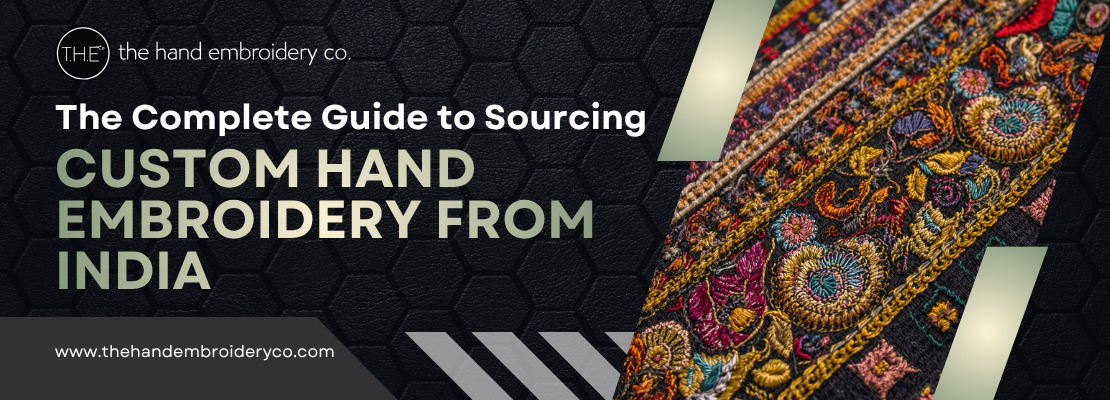
India has been the world's embroidery capital for over five centuries. Today, one Mumbai-based company is redefining what it means to source hand embroidery ethically, precisely, and at a scale that serves the world's most demanding luxury brands — The Hand Embroidery Company (T.H.E. Co.).
Why India Remains the Global Capital of Hand Embroidery
When global fashion houses seek hand embroidery for their haute couture lines, and when five-star hotels look for embroidered textiles that speak of heritage and craft, the answer almost always traces back to one country: India. And within India, to the ateliers of Mumbai, Lucknow, Surat, and Delhi — where artisanal knowledge has passed from generation to generation for hundreds of years.
What makes Indian hand embroidery irreplaceable is not just the technique but the accumulated intelligence of the artisan. A master zardozi craftsperson understands how a metallic thread will catch light differently on velvet versus silk organza. An aari-work specialist knows precisely how much tension to maintain through a hooked needle to ensure uniform loops across a fabric that may be two metres wide. This embodied knowledge cannot be digitised or replicated by machine — and it is this very truth that makes India's hand embroidery ecosystem so irreplaceable in global luxury supply chains.
"Every stitch is a conversation between the artisan and the fabric. At T.H.E. Co., we make sure that conversation produces something extraordinary every single time." - Suraj Punjabi
The Major Techniques of Indian Hand Embroidery — A Reference Guide
Understanding the different embroidery techniques is essential when briefing a manufacturer. Each method has distinct characteristics, appropriate fabric pairings, lead times, and price points. Here is a comprehensive reference:
Technique |
Description |
Best Used For |
Key Materials |
|---|---|---|---|
Zardozi |
Opulent metal wire and thread embroidery originating from Mughal courts. Produces raised, textured designs with extraordinary shimmer. |
Bridal couture, evening gowns, ceremonial garments, luxury cushions |
Gold/silver wire, silk thread, velvet, satin |
Aari Work |
Executed with a hooked needle (aari) to create continuous chain stitches. Allows highly detailed, fine designs with fluid lines. |
Shawls, sarees, lehengas, home textiles |
Silk thread, wool, organza |
Chikankari |
Delicate, shadow-work embroidery from Lucknow. Features a variety of stitches creating a translucent, layered effect on fabric. |
Kurtas, sarees, lightweight summer wear |
Muslin, cotton, georgette |
Kantha |
Running stitch embroidery from Bengal. Originally used to repurpose old saris into quilts; now a celebrated artform for its geometric and narrative motifs. |
Stoles, quilts, fashion outerwear, home textiles |
Cotton, silk |
Phulkari |
Floral embroidery from Punjab using silk thread on coarse cotton. Characterised by vibrant colours and geometric patterns that cover the entire fabric surface. |
Dupattas, shawls, ethnic fashion |
Khaddar (handspun cotton), silk floss |
Beadwork & Sequin |
Attachment of glass beads, sequins, crystals, or pearls to create glittering surface embellishment. Can be combined with any embroidery technique. |
Eveningwear, bridal, accessories, luxury interiors |
Glass beads, Swarovski crystals, sequins, pearls |
Mirror Work (Shisha) |
Small pieces of reflective mica or glass are stitched onto fabric using decorative satin stitches. A hallmark of Kutchi and Rajasthani embroidery traditions. |
Festive garments, interior cushions, wall art |
Mirror pieces, coloured cotton thread |
What Makes T.H.E. Co. Different from Other Embroidery Manufacturers?
The hand embroidery manufacturing space in India is large and varied — ranging from individual artisan cooperatives to large factory operations. T.H.E. Co. occupies a unique position in this landscape: a certified export house with 45 years of heritage that operates with the precision of a manufacturing partner and the sensibility of a couture atelier.
1. End-to-End In-House Production
Most embroidery suppliers outsource at least one stage of production — pattern making, stitching, or finishing. certified factories. This vertical integration means tighter quality control, shorter feedback loops, and a single point of accountability for the client.
2. The Free Sample Swatch Programme
Before a client commits to any production run, T.H.E. Co. creates a free sample swatch using the client's chosen design and fabric. This is not a generic demonstration piece — it is a functional preview of the final product, executed with the same artisans and materials that will be used in bulk production. Multiple embroidery techniques can be sampled on the same swatch, allowing the client to compare textures and finishes before deciding.
3. Absolute Design Confidentiality
In an industry where design theft can occur at any point in the supply chain, T.H.E. Co. has built its reputation on an unbreakable commitment to design confidentiality. Client designs are never copied, shared with third parties, or replicated for any other purpose. This ethical stance has made T.H.E. Co. the preferred manufacturing partner for independent designers who cannot afford to have their intellectual property compromised.
4. Materials from Around the World
T.H.E. Co. works with silk threads, metallic wires, glass beads, Swarovski elements, sequins, zari, pearls, organza, velvet, cotton, and dozens of other materials — sourced globally to match the exact specifications of each project. If you have seen it online, T.H.E. Co. can work with it.
Related Article - The Future of Hand Embroidery: Global Trends Shaping 2026 & Beyond
How to Place a Custom Embroidery Order with T.H.E. Co.
T.H.E. Co.'s production process is designed to be accessible to first-time clients while delivering the rigour that experienced luxury brands demand. Here is what the journey looks like:
1. Share Your Design or Tech Pack
Send your design brief, tech pack, mood board, or even a rough sketch. No tech pack? No problem — the team will guide you through exactly what information is needed to get started.
2. Receive Your Free Sample Swatch
Artisans create a physical swatch using your chosen embroidery technique and fabric. Multiple techniques can be demonstrated on a single swatch for comparison.
3. Material Sourcing
Once the swatch is approved, T.H.E. Co. sources all raw materials — fabric, lining, threads, beads, and any specialist embellishments required by your design.
4. Pattern Making
In-house experts create production-ready patterns scaled to your exact size specifications and garment constructions.
5. Hand Embroidery Production
Skilled artisans execute the embroidery by hand — zardozi, aari, threadwork, beading, or any combination — with each piece receiving the same level of attention regardless of order volume.
6. Final Stitching, QC & Dispatch
Expert tailors assemble each garment with precision. A final quality inspection ensures every piece meets specification before worldwide dispatch.
Related Article - Embroidered Abaya & Kaftan Trends in the Middle East (2026 Fashion Guide)
Who Should Work with T.H.E. Co.?
T.H.E. Co. is structured as a B2B embroidery export house, which means it works primarily with businesses rather than individual consumers. The typical client profile includes:
Fashion designers and design houses
Bridal and occasion-wear brands
Bridal labels in the UK, Middle East, USA, and Australia who require intricate beading, zardozi, and threadwork on wedding gowns, lehengas, and kaftans.
Luxury hotel and interior brands
Hotels, interior designers, and hospitality groups seeking embroidered cushions, wall hangings, table runners, and decorative textiles that communicate heritage and craft.
Textile importers and wholesale buyers
Fabric wholesalers and garment importers looking to source finished embroidered fabrics or ready-to-sell embroidered garments for distribution.
Global Trends Driving Demand for Hand Embroidery in 2026
The market for artisanal and hand-crafted textiles is growing. Several converging trends are driving this:
The slow fashion movement
Global consumers and brands are moving away from disposable fast fashion toward pieces that carry provenance, craftsmanship, and longevity. Hand embroidery is the ultimate expression of slow fashion — each piece is inherently unique, time-intensive, and built to last.
Luxury tourism and hospitality
As five-star hotels invest in distinctive guest experiences, embroidered textiles — from monogrammed pillowcases to hand-embroidered wall panels — have become a key differentiator in interior design.
Middle Eastern bridal fashion
The Gulf region's appetite for embroidered abayas, kaftans, and bridal garments continues to grow, with designers in Dubai, Riyadh, and Kuwait increasingly sourcing from India's embroidery ateliers.
Western fashion's embrace of global craft
From Dior's Indian-inspired haute couture collections to independent British designers referencing Mughal motifs, Western fashion's relationship with Indian embroidery craft is deeper than ever.
Related Article - How Luxury Hotels Use Hand Embroidery in Interior & Guest Experience
Frequently Asked Questions
What is the minimum order quantity for custom hand embroidery?
What embroidery techniques does T.H.E. Co. specialise in?
T.H.E. Co. specialises in zardozi (gold and silver wire embroidery), aari work, chikankari, kantha, phulkari, threadwork, beaded embroidery, sequin work, and mirror work (shisha). Each technique is executed by specialist artisans with decades of experience in that specific craft.
How do I get a sample swatch before placing a bulk order?
T.H.E. Co. offers a free sample swatch programme. Share your design or tech pack, and the artisans will create a physical sample using your chosen fabric and embroidery technique. This lets you evaluate the quality and approve the design before committing to production.
Does T.H.E. Co. ship internationally?
Yes. T.H.E. Co. ships to over 12 countries and partners with multiple international courier services to offer competitive shipping rates and reliable delivery. Clients can also nominate their preferred logistics provider.
Is my design protected when I share it with T.H.E. Co.?
Absolutely. Design confidentiality is a foundational value at The Hand Embroidery Company. Client designs are never copied, replicated, or shared under any circumstance. This is why over 155 clients — many of them independent designers with no legal team — trust T.H.E. Co. with their most sensitive creative work.
What materials can T.H.E. Co. work with?
T.H.E. Co. works with a wide range of materials including silk threads, metallic wires, beads, sequins, zari, pearls, organza, velvet, cotton, and more — all sourced globally. If a material exists in the market, the team can source and work with it for your project.
Where is The Hand Embroidery Company located?
T.H.E. Co. is a bespoke export house based in Mumbai, India, with certified manufacturing facilities. The company ships globally and has served clients across the USA, UK, Middle East, Europe, Australia, and Asia.