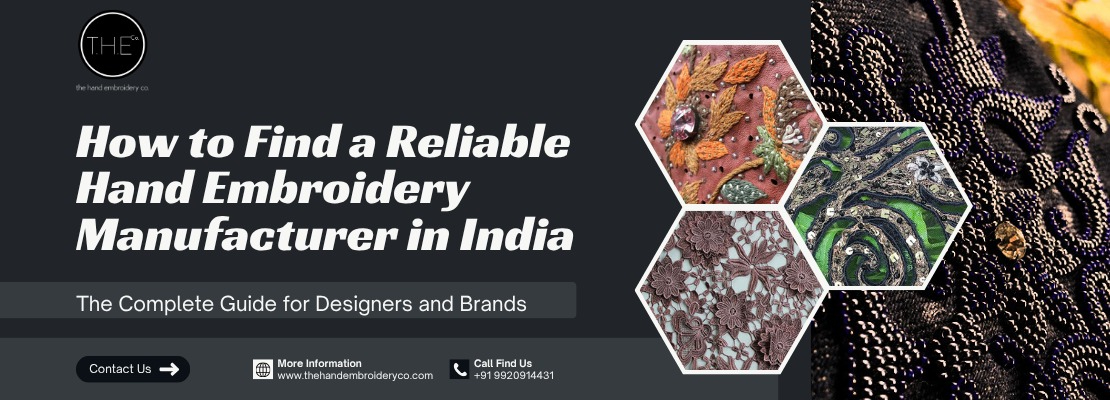
If you design clothes, bags, bridal wear, or home décor, and you want that rich, hand-worked embroidery look, sooner or later your search leads to the same place: India. For hundreds of years, India has been the world's centre for hand embroidery. Big fashion houses in Paris, Milan, New York and London quietly send their most detailed, most expensive designs to small workshops in Mumbai, Lucknow and Delhi to be embroidered by hand.
But here's the problem. If you search "hand embroidery manufacturer India" on Google, you get hundreds of results. Some are genuine export houses with real artisans and years of experience. Others are middlemen who outsource your order to someone else, or new websites with no track record at all. As a designer or brand owner, especially one ordering from another country, how do you tell the difference?
This guide answers that question in plain, simple language. No jargon, no confusing textile terms without explanation. By the end, you will know exactly what to check, what questions to ask, and what red flags to avoid before you send your design and your money to a manufacturer you have never met in person.
Why India Is the World's Hub for Hand Embroidery
Before we get into how to choose a manufacturer, it helps to understand why India became the go-to country for this work in the first place.
A tradition passed down through generations. In India, hand embroidery is not something people learn in a classroom. It is a skill passed from father to son, mother to daughter, master craftsman to apprentice, often within the same family for generations. Techniques like Zardozi, Aari work, and Chikankari have existed in India for hundreds of years, some dating back to the Mughal era. This means the artisans working on your garment today carry decades, sometimes generations, of inherited skill.
A large pool of skilled artisans. Cities like Mumbai, Lucknow, Delhi, and Surat are home to thousands of trained embroidery artisans. This large workforce means embroidery houses can take on both small custom orders and large bulk production, something that is very hard to find in Western countries where hand embroidery has almost disappeared as a commercial skill.
Lower cost without lower quality. Because of the scale of the industry and the cost of living in India compared to Europe or the US, hand embroidery can be produced at a fraction of the cost you would pay for the same handwork done in Paris or New York, without compromising on the finish or detail.
Global trust built over decades. Luxury brands such as Dior, Gucci, Chanel, and countless bridal houses have been sourcing embroidery from India for decades. This built the country's reputation as a serious, professional embroidery export hub, not a hobbyist market.
Understanding this background matters because it tells you something important: the good manufacturers in India are genuinely world-class. Your job is simply to filter out the unreliable ones and find a partner who matches that standard.
Hand Embroidery vs Machine Embroidery: Know the Difference First
Before you even start looking for a manufacturer, it's worth understanding what you are actually asking for, because many suppliers blur this line.
Hand embroidery is done entirely by an artisan's hands, using a needle, hook, or small tool called an "aari," working directly on the fabric stretched over a frame. It takes longer — sometimes days or weeks for a single garment panel — but the result has depth, texture, and a level of detail that is very hard to replicate with a machine. Every piece has small natural variations, which is part of its charm and value.
Machine embroidery is done using computerised or manual embroidery machines that stitch a pre-programmed design very quickly and consistently. It is faster and cheaper, and good for simple, repeated patterns, but it lacks the raised texture, dimension, and hand-finished richness of real hand embroidery.
Why this matters when choosing a manufacturer: Some suppliers advertise "handmade" but actually produce machine work, or use a machine for the base and hand-finishing only for small details, then market the whole piece as "hand embroidered." If your brand's value is built around authentic handwork — which matters a lot for bridal wear, couture, and luxury accessories — always confirm exactly how much of the work is done by hand versus machine, and ask for close-up sample photos or a small trial swatch before committing.
Related Article - Hand Embroidery vs. Machine Embroidery: Craftsmanship, Precision, and Style Compared
Popular Indian Hand Embroidery Techniques You Should Know
When you start talking to manufacturers, you will hear certain technique names again and again. Knowing what they mean will help you communicate your vision clearly and understand what you are being quoted for.
Zardozi is a heavy, metallic embroidery technique using gold and silver threads, along with beads, sequins, and sometimes small stones. It has a rich, regal, bridal look and is commonly used for wedding lehengas, bridal gowns, and formal wear. It is labour-intensive and generally one of the more expensive techniques.
Aari work uses a hook-like needle (called an aari or tambour hook) to create fast, continuous chain stitches. It is often used for filling large areas with beads, sequins, or thread work, and is popular for both bridal wear and ready-to-wear fashion because it can achieve dense, detailed coverage relatively efficiently.
Chikankari originates from Lucknow and is a delicate, white-on-white or subtle thread embroidery technique, traditionally done on light fabrics like cotton and georgette. It has a soft, breathable, everyday-elegant look, very different from the heavy bridal styles.
Resham work refers to embroidery done using silk thread, known for its smooth, glossy finish. It is often combined with other techniques for added richness.
Mirror work (Shisha embroidery) incorporates small mirrors stitched into the fabric using decorative thread patterns around the edges, giving a sparkling, folk-inspired look popular in bohemian and festival fashion.
Cutdana and sequin work involves stitching small glass beads (cutdana) or sequins onto fabric in patterns, adding shine and texture, commonly used in both bridal and evening wear.
Beaded embroidery more broadly refers to any technique that incorporates beads, pearls, crystals, or stones into the stitching, and can range from subtle accents to fully beaded, heavy panels.
Knowing these terms means that when you approach a manufacturer, you can say exactly what you want — "I need Zardozi work on a velvet bodice with a beaded border" — instead of a vague description that could be interpreted many different ways.
Related Article - Trending Techniques in Hand Embroidery: The Modern Evolution of a Timeless Craft
What to Check Before You Choose a Hand Embroidery Manufacturer
This is the most important part of this guide. Here is a detailed breakdown of everything you should verify before placing an order, especially your first one.
1. Confirm they genuinely specialise in hand embroidery
Ask directly: "Is this work done fully by hand, or is machine work involved?" A trustworthy manufacturer will explain clearly which parts of the process are hand-done and which, if any, use machines. Ask for video or close-up photos of artisans actually working, not just finished product shots, which can sometimes be sourced from elsewhere.
2. Ask how they protect your design
This is one of the biggest fears designers have when outsourcing production internationally — that their unique design idea gets copied, reused for another client, or resold. Before sharing any sketches or tech packs, ask the manufacturer directly whether they have a written policy against copying, replicating, or sharing client designs. A serious, professional manufacturer will be happy to confirm this and may offer a non-disclosure agreement (NDA) if you request one for larger projects.
3. Understand their Minimum Order Quantity (MOQ)
MOQ is the smallest quantity a manufacturer will agree to produce for a single design. This varies enormously between manufacturers — some only accept large bulk orders of hundreds of pieces, while others are flexible and set MOQ based on the complexity of the specific design. If you are a small or new brand testing the market, look for manufacturers who are open to smaller trial orders, or whose MOQ policy explicitly depends on the design rather than being a fixed high number.
4. Check their international export experience
A manufacturer who has already shipped orders to countries like the US, UK, Canada, Italy, or the UAE will understand international sizing standards, customs documentation, export packaging, and realistic delivery timelines. Ask how long they have been exporting, and to which countries. This experience reduces the risk of delays, paperwork issues, or quality misunderstandings that are more common with manufacturers who have only sold domestically within India.
5. Review their fabric and technique range
A manufacturer who can work across multiple fabrics — silk, velvet, net, tulle, organza, chiffon, georgette — and multiple embroidery techniques gives you the flexibility to bring different design ideas to life without needing to find a new supplier for every project. Ask for a portfolio or sample catalogue covering the range of work they have done.
6. Test their communication and response time
Since you will likely be managing this relationship remotely, from another country, communication matters enormously. Before placing an order, send a detailed enquiry and see how quickly and clearly they respond. Do they answer your specific questions, or send generic replies? Do they offer to communicate over WhatsApp or email for faster back-and-forth? A manufacturer who is slow or vague before you've even placed an order is unlikely to improve once you're mid-production.
7. Ask for references or past client examples
While many manufacturers cannot reveal confidential client names due to their own non-disclosure agreements, most can show you a portfolio of past work, testimonials, or examples of the categories of clients they've worked with (bridal brands, ready-to-wear labels, accessory brands, and so on).
8. Clarify pricing structure upfront
Understand exactly what is included in the quoted price — is it just the embroidery work, or does it include the base fabric, backing material, beads and embellishments, and finishing? Ask whether pricing is per piece, per metre, or based on design complexity, so you can compare quotes accurately between different manufacturers.
9. Ask about sampling before bulk production
Never place a large bulk order without first approving a physical sample. A reliable manufacturer will offer to create a sample swatch or single piece so you can check thread colour accuracy, stitch density, bead quality, and overall finish before committing to full production.
10. Understand their quality control process
Ask how they check quality before shipping — do they inspect every piece, or only a sample from each batch? What happens if a defect is found after your order is shipped? A manufacturer with a clear, described quality control process is far more reliable than one who simply says "don't worry, quality is good."
Related Article - From Sketch to Stitch The Creative Process of Embroidered Art
Understanding Minimum Order Quantity (MOQ) in Detail
MOQ is one of the most confusing topics for first-time buyers, so it deserves a deeper explanation.
Embroidery, especially hand embroidery, is very labour intensive. Setting up a design — training artisans on a specific pattern, sourcing the right beads or threads, planning the stitch layout — takes time regardless of whether you order 10 pieces or 1,000. This is why many manufacturers set a minimum order quantity: it ensures the setup effort is worthwhile for their production team.
However, MOQ is not always a fixed number across the board. It often depends on:
- Design complexity — simpler, faster designs may have a lower MOQ than intricate, time-heavy patterns.
- Fabric and material cost — if premium fabric or beading material needs to be bought specifically for your order, the manufacturer may require a higher MOQ to make the purchase worthwhile.
- Relationship stage — some manufacturers offer lower MOQs for a first trial order to build trust, with the expectation of larger repeat orders once you're satisfied with quality.
Tips for Negotiating MOQ as a Small or New Brand
- Be upfront that you are a smaller or newer brand testing designs, rather than trying to hide it — many manufacturers are willing to work with growing brands they see long-term potential in.
- Offer to pay a slightly higher per-piece price in exchange for a lower quantity, which can make it worthwhile for the manufacturer despite the smaller order.
- Start with one or two designs at a small quantity to build a working relationship, then scale up your order sizes once trust is established on both sides.
How Much Does Hand Embroidery Cost? A Simple Pricing Guide
Pricing for hand embroidery can vary enormously, and understanding what drives the cost will help you set realistic budgets and evaluate quotes.
Factors that increase cost:
- Technique complexity — heavy, dense techniques like Zardozi or fully beaded panels cost more than lighter, simpler thread work like Chikankari.
- Material quality — real metallic zari thread, quality glass beads, or genuine crystals cost more than synthetic alternatives.
- Coverage area — a fully embroidered gown costs significantly more than a garment with embroidery limited to a border or a few motifs.
- Turnaround time — rush orders that require artisans to work faster or in larger teams typically cost more than orders with a standard, relaxed timeline.
- Customisation level — a completely original, hand-drawn custom design usually costs more to develop than adapting an existing pattern from the manufacturer's library.
Factors that reduce cost:
- Larger order quantities — cost per piece typically decreases as quantity increases, since setup costs are spread across more units.
- Simpler, repeated patterns — designs that don't require constant adjustment are faster and cheaper to produce.
- Standard fabric choices — using fabrics the manufacturer already stocks, rather than sourcing something unusual, can reduce lead time and cost.
Step by Step: How an Embroidery Export Order Actually Works
For first-time international buyers, the entire process from first contact to receiving your finished order can feel unclear. Here is a simple, realistic breakdown of what typically happens.
Step 1: Initial enquiry
You contact the manufacturer with your design idea, reference images, fabric preference, and estimated quantity. Be as specific as possible — vague enquiries get vague answers.
Step 2: Discussion and quotation
The manufacturer asks clarifying questions about your design, technique preference, and timeline, then provides an estimated price and delivery timeline based on your requirements.
Step 3: Sampling
Before bulk production, the manufacturer creates a sample swatch or a single finished piece so you can check thread colours, stitch quality, bead placement, and overall look and feel.
Step 4: Sample approval and adjustments
You review the sample and request any changes — colour adjustments, stitch density, design tweaks. This back-and-forth may take one or two rounds before final approval.
Step 5: Order confirmation and advance payment
Once you approve the sample, you confirm the final order quantity and typically pay a deposit (commonly 30–50%) to begin bulk production.
Step 6: Bulk production
Artisans begin working on your full order. Depending on complexity and quantity, this can take anywhere from a few weeks to a couple of months.
Step 7: Quality check
Before shipping, the manufacturer inspects the finished pieces for consistency, stitch quality, and any defects.
Step 8: Packing and export documentation
The order is carefully packed for international shipping, and export paperwork (invoice, packing list, and any required customs documents) is prepared.
Step 9: Shipping and final payment
The order is shipped via courier or freight, depending on size, and the remaining balance payment is typically settled either before shipping or upon delivery, as agreed.
Step 10: Delivery and feedback
You receive your order, inspect it against the approved sample, and share feedback — which also helps build a smoother, faster process for your next order.
Knowing this process in advance helps you set realistic expectations on timelines and payments, and makes it easier to spot a manufacturer who skips important steps like sampling or quality checks.
Hand Embroidery on Different Fabrics
The base fabric you choose affects both the look of the embroidery and how it should be produced. Here's a simple breakdown of common fabric choices.
Silk takes embroidery beautifully, with a natural sheen that enhances metallic threads and beadwork. It's a popular choice for bridal wear and formal garments, though it requires careful handling during the embroidery process to avoid puckering.
Velvet provides a rich, plush base that pairs especially well with Zardozi and heavy beadwork, commonly seen in winter bridal wear and luxury outerwear. Its texture can make very fine, delicate embroidery harder to see, so it works best with bolder, denser designs.
Net and tulle are lightweight and sheer, often used for veils, overlays, and airy bridal gowns. Because they are delicate, embroidery on these fabrics generally needs a lighter touch and careful stabilising during the stitching process.
Organza has a crisp, structured feel and a subtle shine, often used for contemporary bridal and eveningwear where a lighter, more architectural look is desired.
Georgette and chiffon are soft, flowy fabrics often used for everyday and semi-formal wear. Techniques like Chikankari, with its lighter thread work, suit these fabrics particularly well.
Cotton is breathable and practical, commonly used for Chikankari and other lighter, everyday embroidery styles, especially in warm climates.
When approaching a manufacturer, mentioning your intended fabric early in the conversation helps them recommend the most suitable technique and give you a more accurate quote.
Beaded Embroidery vs Non-Beaded Embroidery
Understanding this distinction helps you communicate your vision clearly.
Non-beaded embroidery relies purely on thread work, using techniques like Aari, Resham, or Chikankari to create texture and pattern without any added embellishments. It tends to have a softer, more understated look, and is generally lighter in weight and slightly faster to produce.
Beaded embroidery incorporates beads, sequins, pearls, crystals, or stones into the stitching, adding shine, texture, and often significant weight to the finished piece. It tends to have a bolder, more glamorous look, commonly chosen for bridal wear and eveningwear, but requires more time, material cost, and careful quality control to ensure beads are securely attached and evenly placed.
Your choice between the two often comes down to the occasion and aesthetic of your final garment — understated elegance versus bold, statement glamour.
Related Article - Beaded Embroidery: A Timeless Art of Elegance and Craftsmanship
How to Protect Your Fashion Design When Outsourcing Embroidery
This deserves its own detailed section because it's one of the most common concerns designers raise before working with any overseas manufacturer.
Share designs progressively, not all at once. For a very sensitive or highly original design, consider sharing only what's needed for an initial quote first, and the full detailed tech pack only once you've decided to move forward with a specific manufacturer.
Ask for a written confidentiality commitment. Even a simple written email confirmation that your design will not be copied, replicated, or shared with other clients provides a paper trail. For larger, high-value projects, consider a formal Non-Disclosure Agreement (NDA).
Watermark reference images when appropriate. If you're sharing visual references or mood boards rather than final tech packs, watermarking can reduce casual misuse without affecting the manufacturer's ability to understand your vision.
Work with established, reputation-driven manufacturers. A manufacturer who has built a long-term export business with international clients has far more to lose from a reputation-damaging design leak than a small, anonymous workshop with no track record.
Keep records of all communication. Save your emails, WhatsApp conversations, and any agreements. This documentation protects you if a dispute ever arises.
Trust your instincts. If a manufacturer avoids answering your questions about design protection clearly, or seems evasive, treat that as a warning sign and consider other options.
Why Mumbai Remains a Global Hub for Luxury Hand Embroidery
If you look closely at where India's top embroidery export houses are based, Mumbai comes up again and again. This isn't a coincidence.
Mumbai's embroidery industry grew alongside its position as India's fashion and film capital, giving it early exposure to high-end, detail-driven design work. Many of the manufacturers who now export globally started by supplying local designers and Bollywood costume work, which demanded exceptionally high standards of finishing and speed.
Over the decades, this created a concentrated ecosystem in Mumbai — skilled artisans, experienced pattern makers, embellishment suppliers, and export logistics companies all operating in close proximity to each other. For a designer or brand sourcing embroidery, this concentration means Mumbai-based manufacturers often have easier access to a wider variety of beads, threads, and fabrics, along with artisans experienced in working to international quality standards.
Sustainable and Ethical Embroidery Manufacturing: What to Look For
As more fashion brands prioritise ethical sourcing, it's worth understanding what to look for in an embroidery manufacturer beyond just price and quality.
Fair working conditions. Ask whether artisans work in proper, safe workshop conditions, with reasonable hours and fair pay, rather than unregulated home-based piecework with no oversight.
Preservation of traditional skills. Manufacturers who actively train and employ artisans in traditional techniques like Zardozi and Aari work contribute to keeping these dying crafts alive, rather than replacing them entirely with machine alternatives.
Transparency about their process. A manufacturer willing to be open about where and how the work is done — rather than being vague about their supply chain — is generally a positive sign of an ethically run operation.
Material sourcing. If sustainability matters to your brand, ask about the sourcing of beads, threads, and fabrics, and whether more sustainable material options are available.
Choosing a manufacturer who values both craftsmanship and fair treatment of artisans isn't just an ethical choice — for many modern consumers, it's also becoming an important part of a brand's story and marketing.
Common Mistakes First-Time Buyers Make
Skipping the sample stage to save time. This almost always backfires, resulting in a bulk order that doesn't match expectations, with no way to fix it before shipment.
Choosing the cheapest quote without asking why it's cheaper. Unusually low prices often mean compromised materials or hidden shortcuts.
Not clarifying what's included in the price. Some quotes include fabric and embellishments, others only cover the embroidery labour — always ask explicitly.
Vague design briefs. Sending a single low-resolution reference image without colour codes, size details, or technique preference leads to miscommunication and costly revisions.
Ignoring communication red flags. Slow, vague, or inconsistent communication before an order is placed rarely improves after your money and design are already committed.
Not planning enough lead time. Hand embroidery takes real time to produce properly — rushing a manufacturer for an unrealistic deadline often results in lower quality or missed dates.
Simple Pre-Order Checklist
Before placing your first order with any hand embroidery manufacturer, make sure you can tick off the following:
- Confirmed the work is genuinely hand-done, with proof (photos or video)
- Received a written confidentiality or design protection commitment
- Understood their MOQ policy for your specific design
- Confirmed their international export experience
- Reviewed their fabric and technique portfolio
- Tested their communication speed and clarity
- Understood exactly what is included in the quoted price
- Approved a physical sample before bulk production
- Understood their quality control process
- Agreed on realistic timelines and payment terms in writing
Comparing Embroidery Hubs Across India
While Mumbai is a major centre, India has several regional embroidery hubs, each with its own specialty. Knowing this can help you understand what a manufacturer's background tells you about their strengths.
Lucknow is famous for Chikankari — the delicate, white-on-white thread work tradition that dates back generations. If your design needs soft, breathable, everyday-elegant embroidery, a manufacturer with strong Lucknow roots is often a good fit.
Surat, in Gujarat, is one of India's largest textile and embroidery production centres, known for handling both fabric manufacturing and embroidery at scale, often at competitive pricing due to its concentrated supply chain.
Delhi has a long history of Zardozi work, with many export houses supplying detailed metallic and beaded embroidery for bridal and couture markets.
Mumbai, as covered earlier, is India's luxury fashion capital, combining skilled artisans with strong export infrastructure, international client experience, and access to a wide range of premium materials.
This doesn't mean a manufacturer outside these specific regions can't do excellent work — many export houses source artisans skilled in multiple regional techniques. But understanding these traditional hubs gives you useful context when researching a manufacturer's background and specialisation.
Questions to Ask on Your First Call or Email
To make your first conversation with a potential manufacturer as productive as possible, come prepared with these questions:
- Can you show me examples of hand embroidery work similar to my design?
- What is your process for keeping client designs confidential?
- What is your MOQ for a design like this?
- Can I get a sample before committing to a bulk order?
- What fabrics and techniques do you specialise in?
- Have you shipped orders to my country before?
- What is your typical production timeline for an order this size?
- What payment terms do you require, and at what stages?
- What happens if there's a quality issue after I receive my order?
Manufacturers who answer these questions clearly and confidently, without hesitation or vague deflection, are far more likely to be a reliable long-term partner than those who avoid specifics.
Building a Long-Term Manufacturing Relationship
Many designers treat their first embroidery order as a one-time transaction, but the most successful, sustainable fashion brands tend to build long-term relationships with one or two trusted manufacturers instead of constantly switching suppliers.
Why this matters: A manufacturer who understands your brand's style, quality expectations, and preferred techniques over multiple orders can often produce faster, more accurate work than starting fresh with a new supplier every time. They also become more flexible on MOQ and pricing as trust and order volume grow over time.
How to build this relationship well: Communicate clearly and consistently, pay on the agreed terms without delays, give specific and constructive feedback after each order, and be transparent about your future plans and growth, so your manufacturer can plan capacity accordingly.
A strong, trusted manufacturing partnership is often one of the most valuable, and most overlooked, assets a growing fashion brand can build.
About The Hand Embroidery Co.
The Hand Embroidery Co. (T.H.E. Co.) is a hand embroidery export house based in India, working with fashion designers and brands across the US, UK, Canada, Italy, and UAE. We specialise in embroidered, beaded, and non-beaded garments, fabrics, and accessories, created entirely by our team of skilled traditional artisans.
We carry a true ethical spirit as hand embroidery exporters, and we prioritise our clients' needs at every stage of the process. Your design is your identity — we never copy, replicate, or share it under any circumstance. Our minimum order quantity depends on the specific design, which means we can work with both new, growing brands and established international labels.
We specialise in bespoke embroidery solutions for designers, brands, and creative projects worldwide, working across techniques including Zardozi, Aari work, beaded embroidery, and more, on fabrics ranging from silk and velvet to net, tulle, and organza.
Ready to discuss your embroidery project? Email: info@thehandembroideryco.com WhatsApp/Phone: +91 9920914431. For faster communication, please share your mobile number along with your email enquiry.
Frequently Asked Questions
What is a hand embroidery export house?
A hand embroidery export house is a company that produces embroidered fabrics or garments by hand in one country, typically India, and ships (exports) the finished products to designers, brands, and buyers in other countries.
Is hand embroidery more expensive than machine embroidery?
Generally yes, because hand embroidery takes significantly longer and requires skilled artisan labour, whereas machine embroidery is faster and more automated. However, hand embroidery typically offers a richer texture, more detail, and a premium finish that many designers and luxury brands specifically seek out.
Can I order a small quantity to test quality before a bulk order?
Many manufacturers, including The Hand Embroidery Co., are open to smaller trial orders so you can evaluate quality before committing to bulk production. Always ask about this directly, as MOQ policies vary between manufacturers and designs.
How do I make sure my design isn't copied or reused for another client?
Choose a manufacturer who provides a clear, written commitment — through email confirmation or a formal Non-Disclosure Agreement — that your design will not be copied, shared, or resold to anyone else.
What is Zardozi embroidery used for?
Zardozi is a heavy, metallic embroidery technique using gold and silver thread, beads, and sometimes stones. It's most commonly used for bridal wear, wedding lehengas, and formal or couture garments due to its rich, regal appearance.
How long does a typical hand embroidery order take to produce?
This depends heavily on design complexity, technique, and quantity, but hand embroidery generally takes longer than machine work — anywhere from a couple of weeks for smaller, simpler orders to a couple of months for large, detailed bulk production.
Do embroidery manufacturers in India ship internationally?
Yes, many established hand embroidery export houses in India regularly ship to countries including the US, UK, Canada, Italy, UAE, and beyond, handling export documentation and international courier or freight shipping as part of the order process.
What fabrics work best for hand embroidery?
Silk, velvet, net, tulle, organza, georgette, and cotton are all commonly used, with the best choice depending on your design style — heavier fabrics like velvet suit dense, bold embroidery, while lighter fabrics like georgette and cotton suit more delicate thread work.