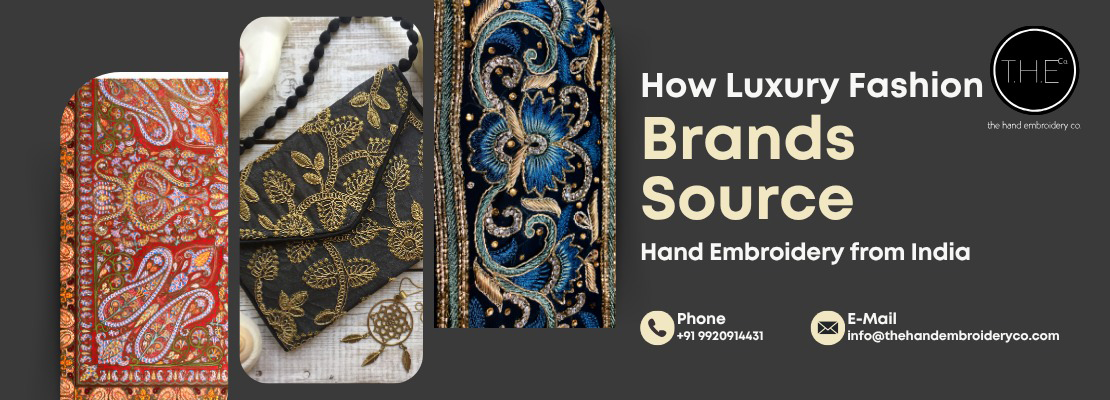
Luxury fashion brands source hand embroidery from India by partnering with certified export ateliers in Mumbai, Lucknow, and Kolkata. The process involves identifying a specialist manufacturer, sharing design briefs or tech packs, approving a sample swatch, confirming MOQ and lead times, and signing confidentiality agreements before production begins. Brands like Dior, Hermès, Valentino, and Gucci have all sourced from Indian embroidery ateliers for decades.
There is a coat sitting in Dior's archive — a knee-length jacket embellished entirely with tiny mirrors — that took 34 days to make. Twelve embroiderers worked on it simultaneously. The total cost of the piece was estimated at over ₹1.67 crore. When it finally appeared in the Dior Homme Menswear spring-summer 2026 collection at Paris Fashion Week in June 2025, no credit was given to the artisans who made it.
The coat was made in India.
This story — reported across THR India, Bloomberg, and Business of Fashion — tells you everything you need to know about the relationship between global luxury fashion and Indian hand embroidery. The craft is irreplaceable. The artisans are world-class. The techniques are centuries old. And for decades, the biggest fashion houses in the world have been flying quietly to Mumbai, Kolkata, and Lucknow — commissioning work that defines their most celebrated collections — while keeping the supply chain almost entirely hidden from public view.
That silence is finally ending.
Dior staged its Pre-Fall 2023 collection at the Gateway of India, openly celebrating its collaboration with the Chanakya School of Craft in Mumbai. Louis Vuitton's Pharrell Williams spent seven days in Delhi, Mumbai, and Jodhpur researching the Spring 2026 menswear collection — a show that became a masterclass in how luxury fashion should engage with Indian heritage. Hermès has cultivated relationships with Indian embroidery ateliers for over twenty years.
The world's most valuable fashion houses have known what Indian craft can do for a long time. This guide explains exactly how they source it — and what any fashion brand, at any scale, can learn from that process.
Related Article - Trending Hand Embroidery Techniques in 2026
Why Luxury Brands Come to India for Hand Embroidery
Before understanding the sourcing process, it is worth being honest about why India has become the world's essential hand embroidery source. Because the answer is not simply "it's cheaper" — and any brand that treats India as a cost-cutting exercise will eventually discover the limits of that thinking.
The Skill Cannot Be Replicated
A knee-length jacket embellished entirely with tiny mirrors took more than 2,000 hours to embroider in India, according to exporters in Mumbai. That number is not an anomaly — it is a reflection of what complex hand embroidery actually requires. Zardozi, aari, chikankari, goldwork, mirror work — these are not techniques that can be learned in months or replicated by machine. They are the product of generations of unbroken craft transmission, passed from parent to child in workshops across northern India.
Leading luxury houses like Dior, Gucci, and Chanel rely extensively on Indian craftsmanship for their most elaborate creations. Dior's Autumn/Winter 2023 collection, showcased at Mumbai's Gateway of India, featured 25 different Indian embroidery techniques including phulkari, kanta, and mirror work.
Twenty-five techniques. In a single collection. From a single country.
That is not a supply chain decision. That is a creative decision — made by some of the most demanding creative directors in the world — because no other source delivers this range of artisan skill.
India Has the Deepest Craft Heritage in the World
Techniques like zardozi, phulkari, block printing, bandhani, mirror work, and intricate weaving have been perfected over centuries. A single pair of handcrafted Kolhapuri chappals can take up to two weeks to make. That kind of time, attention, and tradition can't be replicated by machines.
This depth of heritage is not just aesthetically valuable — it is commercially valuable. In a market where luxury consumers are increasingly demanding authenticity, craft origin, and artisan story, Indian embroidery offers something that no amount of European manufacturing infrastructure can provide: a living, documented, centuries-old tradition. Every sari, every embroidered panel, every hand-dyed fabric carries a narrative. Brands that can weave this storytelling into their collections instantly connect with modern consumers — especially Gen Z and millennials who crave authenticity and heritage.
The Value-to-Quality Ratio Is Extraordinary
Hermès, Gucci, Prada and Christian Dior have all tapped ateliers in India to do exquisite handwork for the catwalk. These are not brands that compromise on quality. They are the global benchmark for quality. Their choice of India as an embroidery source is not a cost decision — it is a quality decision.
For independent luxury labels and emerging designers, this means something important: the same calibre of craftsmanship that Dior and Hermès commission in India is available to you. The artisan tradition is not exclusive to the conglomerates. A certified export house like T.H.E. Co. works with fashion labels of every scale — from a single designer preparing their first collection to an established label placing seasonal production orders.
How Luxury Brands Actually Source Indian Embroidery — The Real Process
This is where most sourcing guides stop at generalities. This one doesn't.
Stage One: Identifying the Right Atelier
The way luxury fashion houses identify embroidery partners in India falls into three categories:
Direct atelier relationships
the largest houses (Dior, Hermès, Valentino) have long-standing, exclusive or semi-exclusive relationships with specific Indian ateliers. It is unclear whether the embroideries and other handwork produced by India-based artisanal ateliers like Chanakya and Les Ateliers 2M for brands such as Dior, Hermès, Gucci and Prada count toward local sourcing requirements — but the relationships themselves are deep, multi-year, and built on trust developed through repeated collaboration.
Trade fair discovery
Première Vision in Paris, Magic in Las Vegas, and Texworld are venues where Indian export houses present their work to international buyers. Many significant sourcing relationships begin with a booth visit at a trade show.
Referral and reputation
the luxury fashion world is a small one. When a creative director finds an Indian manufacturer who delivers consistently on complex work, that recommendation travels. Many of T.H.E. Co.'s current 155 clients came through the recommendation of a previous client.
The lesson for independent labels
You do not need to be LVMH to access the Indian atelier system. What you need is the same thing every luxury house needed when they started: the willingness to reach out directly, share a design brief, and start with a swatch.
Stage Two: The Initial Design Conversation
When designers collaborate directly with artisans — like Dior's partnership with Mumbai's Chanakya School of Craft — they create authentic cultural exchange that benefits both parties and preserves traditional skills for future generations.
The most successful luxury sourcing relationships are collaborative from the very first conversation — not transactional. The best creative directors do not arrive with a locked design and demand replication. They arrive with a direction and let the artisan expertise shape what is possible.
This is exactly how T.H.E. Co. works. When a designer sends a mood board — even a loose one, even just a reference image from a runway — our team responds not just with "can we do this?" but with "here are three ways we could interpret this, and here is what each one would look and feel like on your fabric."
What a luxury-level design brief contains:
- The design concept or reference image
- The intended technique (or openness to technique suggestion from the manufacturer)
- The base fabric — or a fabric swatch if available
- The application: garment type, embroidery placement, construction detail
- Colour palette: Pantone references, physical colour swatches, or reference imagery
- Collection timeline: when does the finished order need to be delivered?
- Quantity: even a range is enough to begin
The more specific the brief, the faster the swatch process. But specificity is not a prerequisite. T.H.E. Co.'s artisan team brings 45 years of experience to every brief — translating creative vision into production-ready embroidery is part of what we do.
Stage Three: The Sample Swatch — The Most Important Step Every Brand Skips
Here is something that separates experienced luxury buyers from first-time sourcing decisions: the ones who have been doing this longest always insist on the sample swatch. Always.
Dior is shifting that narrative by announcing its India supplier, training artisans and working to boost salaries. That level of investment in a supplier relationship starts with sampling — with building a physical understanding of what the atelier can do before a single production unit is committed.
A sample swatch is a small piece of embroidery — typically A5 to A4 in size — created using your actual design on your actual fabric. It shows you:
- The exact thread quality and metallic sheen
- The stitch density and three-dimensional texture
- How the embroidery sits and drapes on your specific fabric
- Bead and embellishment quality, placement, and security
- Whether the colour interpretation matches your palette exactly
At T.H.E. Co., every new client relationship begins with a free sample swatch. No invoice. No commercial commitment. Just embroidery that shows you, in your hands, what your vision looks like realised by 45 years of craft.
This is not a promotional gesture. It is the correct professional process. And it is the single most reliable way to evaluate an embroidery manufacturer before committing production budget.
A manufacturer who does not offer a sample process — or who charges heavily before they have demonstrated anything — is telling you something important about how they prioritise client relationships.
Stage Four: Design Confidentiality and IP Protection
Reportedly, it cost over ₹1.67 crore, took 34 days, and involved 12 embroiderers. Still, no credit was given to the artisans or their craft heritage, prompting immediate backlash.
The question of credit and confidentiality runs in two directions in luxury fashion. Brands want to protect their designs from copying before a collection launches. Artisans, increasingly, want credit for the work they produce. Both concerns are legitimate — and both must be addressed in a well-structured sourcing relationship.
For fashion brands: how to protect your designs
The fear that stops many fashion designers from sourcing from India for the first time is not the craft quality or the logistics. It is this: what happens to my design once I share it?
The answer depends entirely on who you work with. Reputable export houses do not copy client designs. They cannot — their entire business model is built on long-term client trust, and trust built over 45 years is not something any manufacturer would sacrifice for a single design theft.
T.H.E. Co.'s design protection commitment is absolute and public: "Your design is your identity, and we make sure that we protect it. We will never copy, replicate, or share your designs under any circumstance." This commitment has held for 45 years and 155 clients across 12 countries.
Practical steps for any brand:
1. Request and sign a Non-Disclosure Agreement before sharing final design files
2. Share designs in stages — reference images first, full production files after NDA is signed
3. Work with manufacturers who have a documented, public design protection policy
4. Choose manufacturers with a verifiable multi-year track record — not new market entrants
Stage Five: Production, Communication and Quality
Once swatch is approved and commercial terms are agreed, production begins. For luxury fashion brands, the production stage involves more active management than most first-time buyers expect.
What serious luxury buyers do during production:
They request work-in-progress photographs at key milestones — when design transfer is complete, when embroidery reaches 50% completion, and again when the final quality check is done. This is not micromanagement. It is the correct professional standard for high-value hand embroidery production. Catching a colour interpretation issue at 50% costs a conversation. Catching it at delivery costs a collection.
They have a single named contact at the manufacturer — not a shared inbox. The person who knows the design, the fabric, the timeline, and the brand's aesthetic expectations.
They build in buffer time. A luxury collection with dense zardozi work on silk organza does not rush. The artisans who produce it do not cut corners. The lead time exists for a reason — and the brands who respect it receive work that the brands who rush do not.
Typical production timeline for luxury embroidery:
| Stage | Duration |
|---|---|
| Initial brief and swatch creation | 7–14 business days |
| Swatch review, feedback, revision (if needed) | 5–7 days |
| Material sourcing post-approval | 5–10 business days |
| Production (standard to complex) | 4–10 weeks |
| Quality inspection and finishing | 3–5 business days |
| International shipping (air freight) | 3–7 business days |
| Total end-to-end | 10–16 weeks from first contact |
For a luxury collection showing in October, sourcing conversations should begin no later than May. For a bridal collection with dense couture embroidery, earlier is always better.
Related Article - 10 Must-Know Haute Couture Trends Dominating Fashion Week 2025
What Separates a Good Manufacturer from a Great One
The luxury fashion industry has learned — sometimes expensively — the difference between an embroidery supplier and an embroidery partner. Here is what the best relationships look like in practice.
In-House Artisans vs. Subcontracting
The single most important quality variable in hand embroidery production is this: are the artisans employed in-house, on-site, by the manufacturer — or is the work being subcontracted to external units?
When artisans work in-house, the manufacturer controls the output. Quality is consistent between sample and production. Lead times are accurate. Revisions are handled without finger-pointing between contractors.
T.H.E. Co. employs 175+ artisans in-house, at our own certified workshops in Mumbai. No subcontracting. Every swatch and every production piece When work is subcontracted, none of those thing
are made by the same team, in the same facility, to the same standard.
Certified Factories — Why It Matters
Brands like Dior and Valentino are banking on India's high growth potential — and they are doing so with supply chain partners whose operations are independently verified. ISO 9001:2008 quality management certification and SEDEX social compliance certification are not bureaucratic formalities. They are the documented proof that a manufacturer's operations meet international standards for quality, labour practices, and ethical production.
For luxury brands with sustainability commitments — and in 2026, all serious luxury brands have them — working with a certified manufacturer is not optional. It is part of the brand's responsibility to its customers and to its own stated values.
T.H.E. Co. holds ISO 9001:2008, SEDEX, and GC Mark (Global Compliance Mark) certifications — all independently audited. Our factories are REACH-compliant for raw material safety. This documentation is available to every client.
Related Article - Top 10 Free Hand Embroidery Patterns ThehandembroideryCo
Communication Quality Is a Proxy for Production Quality
Luxury fashion houses have learned to read manufacturer quality through the initial communication. A manufacturer who asks intelligent questions about your brief — who wants to understand your collection context, your end customer, your fabric preference before proposing a technique — is a manufacturer who approaches production with the same level of care.
A manufacturer who sends a price list before they have asked a single question about your design is not yet thinking at the standard your collection requires.
The Shift That Changes Everything: India Is No Longer a Secret
From Gucci to Hermès, couture houses have long used Indian techniques — but rarely said so out loud.
That is changing. Fast.
In March 2025, Pharrell Williams spent seven days exploring Delhi, Mumbai, and Jodhpur, immersing himself in India's aesthetic landscape. His Spring 2026 Louis Vuitton menswear collection was built around Indian craft, culture, and artisan collaboration — openly, joyfully, with full credit given to the Indian creatives involved.
Dior is shifting that narrative by announcing its India supplier, training artisans and working to boost salaries. Valentino is leaning into the story. Hermès has acknowledged its twenty-year Indian relationships.
For independent fashion brands and emerging luxury labels, this shift creates an extraordinary opportunity — not to piggyback on a trend, but to do what the major houses are now learning to do properly: build genuine, long-term, transparent relationships with Indian craft partners whose work becomes part of the brand's own story.
The label "Made with Indian hand embroidery" — when it comes with the artisan story, the technique heritage, the certification transparency — is not a compromise. It is a competitive advantage. It is the proof of authenticity and human craft that luxury consumers in 2026 will pay a premium for.
The Hand Embroidery Company has been producing couture-quality hand embroidery for international fashion brands for 45 years. Our workshops are in Mumbai. Our 175+ artisans work in-house. Our clients span 12 countries and 155 brands — from independent designers showing at London Fashion Week to established export labels with seasonal production runs.
This is what the working relationship looks like:
You share your vision. A mood board, a sketch, a reference image, a design concept — whatever stage your creative process is at, we can begin from there.
We create your free sample swatch. Using your design and your fabric (or our recommendation), we produce a physical swatch that shows you exactly what the finished work will look and feel like. No charge. No commitment.
You approve the swatch. If it is right, we move to production. If it needs adjustment, we revise and re-sample until it is exactly what you need.
We produce in-house, with full transparency. Work-in-progress updates throughout production. A named contact who knows your order. Consistent quality from a single team of artisans.
Your designs are protected, always. We have never copied, replicated, or shared a client design in 45 years. We will sign an NDA. We will give you a written design protection commitment before you share a single file.
We ship to your door. International air freight via DHL, FedEx, or your own logistics account. Certificate of Origin provided for all relevant markets. Full export documentation handled by our team.
The Question Worth Asking
Dior waited years before openly crediting its Indian embroidery partners. When it finally did — at the Gateway of India, in a collection built around 25 different Indian techniques, shown to the world — the response was extraordinary. Not controversy. Celebration.
The brands that will define luxury fashion over the next decade are the ones who understand that the story of the craft — who made it, how it was made, what tradition it comes from — is as valuable as the craft itself.
If you are building a fashion label in 2026, you have a choice. You can source embroidery from wherever is cheapest and fastest. Or you can source from an atelier with 45 years of craft history, 175 in-house artisans, and the kind of techniques knowledge that Dior and Hermès have been travelling to India to access for decades.
The craft is here. The relationship starts with a conversation.
WhatsApp T.H.E. Co. directly: +91 9920914431
Email: info@thehandembroideryco.com
Frequently Asked Questions
Do luxury fashion brands really source hand embroidery from India?
Yes — extensively. Dior, Hermès, Valentino, Gucci, Prada, Alexander McQueen, and Balmain have all sourced hand embroidery and artisan craft from India. Dior's partnership with Mumbai's Chanakya School of Craft is one of the most documented examples — their 2023 Pre-Fall collection at Mumbai's Gateway of India featured 25 different Indian embroidery techniques. Hermès has maintained Indian atelier relationships for over twenty years.
How do luxury brands find embroidery manufacturers in India?
Through three main routes: long-term direct atelier relationships built over years of collaboration, trade fair discovery at Première Vision and similar events, and referral through the fashion industry network. Independent brands can access the same manufacturers through direct outreach — most certified Indian export houses welcome new client inquiries regardless of order scale.
What is the difference between an Indian embroidery atelier and an Indian embroidery manufacturer?
The terms are sometimes used interchangeably, but in practice an atelier implies a higher level of creative collaboration, artisan skill, and bespoke production. An export house or atelier employs artisans in-house and works from a client's design brief to produce custom pieces. A manufacturer may subcontract work and operate with less creative flexibility. For luxury fashion sourcing, working with a certified in-house atelier is always the correct choice.
How does design protection work when sourcing embroidery from India?
Reputable export houses protect client designs through formal confidentiality commitments, willingness to sign NDAs, and a track record of client discretion built over years. T.H.E. Co. has never copied, shared, or replicated a client design in 45 years of operation. For any brand, the correct process is: request an NDA before sharing final files, share designs in stages during sampling, and choose manufacturers with a documented, public design protection policy.
What certifications should a luxury fashion brand look for in an Indian embroidery supplier?
ISO 9001:2008 (quality management system), SEDEX (social compliance and ethical labour practices), and REACH compliance (chemical safety of raw materials) are the key certifications. For brands with sustainability commitments or those supplying to retailers with ethical sourcing requirements, SEDEX certification in particular is increasingly a non-negotiable supplier qualification.
Can independent fashion labels access the same quality of Indian hand embroidery as luxury houses?
Yes. The craft tradition and artisan skill that Dior and Hermès access in India is not exclusive to conglomerates. Certified export houses like T.H.E. Co. work with fashion labels of all scales — from a single designer preparing their debut collection to established brands with seasonal production runs. What changes with scale is the MOQ and pricing structure, not the quality of the artisanship.
How long does a luxury hand embroidery order from India take?
From initial brief to international delivery, expect 10–16 weeks for a standard luxury collection order. This includes swatch creation (7–14 business days), swatch approval and material sourcing (2 weeks), production (4–10 weeks depending on complexity and density), quality check and finishing (3–5 days), and international air freight (3–7 days). Planning sourcing at least 4 months ahead of your delivery deadline is the professional standard.