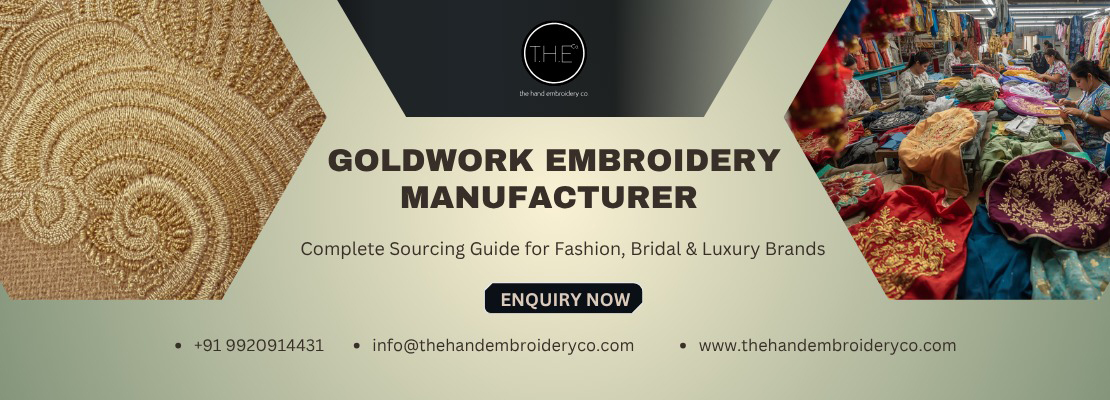
By The Hand Embroidery Co. Team · August 2026 · 24 min read · Goldwork Embroidery · Luxury & Bridal · B2B Sourcing
You've seen it before you could name it. A military dress uniform with a crest that seems to hold its own light. A bridal veil border that catches the flash of every camera at the reception. A Dior gown from an archive photograph, the embroidery so dense with metal thread that the silk underneath nearly disappears. That shimmer — architectural, deliberate, unmistakably expensive-looking even in a photograph — has a name. It's called goldwork, and it is one of the oldest and most technically demanding forms of embroidery in the world.
If you're a fashion designer, bridal house, costume department, regalia maker, or luxury accessories brand reading this, you likely arrived here because you're trying to solve a specific, often frustrating problem: you want genuine goldwork embroidery for a collection, a commission, or a product line, and you're discovering that it is either extremely difficult to source, prohibitively expensive when you do find a workshop, or both. Heritage ateliers in London and Paris that still practise traditional goldwork exist, but their capacity is small, their waitlists are long, and their pricing reflects boutique-scale, not brand-scale, production. If you need goldwork embroidery across a full collection, a bridal line, or a repeat production run — rather than a single museum-piece commission — you need a different kind of partner.
This guide exists to give you that path. We'll walk through exactly what goldwork embroidery is and where it came from, how it relates to India's own centuries-old metal-thread embroidery tradition (a connection most fashion buyers don't know exists, and one that changes what's actually possible for your budget and timeline), where in the world demand for this kind of embroidery is strongest today, realistic cost ranges for 2026, the questions that separate a serious manufacturing partner from a risky one, and exactly what working with a dedicated goldwork manufacturer looks like from your first sketch to a finished, shimmering piece in your hands.
We are The Hand Embroidery Co. (T.H.E. Co.) — a bespoke embroidery export house based in Mumbai, India, with 45 years of combined artisan craftsmanship, more than 5,500 sample swatches produced, 155 brands served, and clients across 12 countries. Our artisans work extensively in metal-thread embroidery — what the West calls goldwork and what India has called zardozi for centuries — and this guide is written to give you an honest, detailed understanding of that craft before you commit any budget to a manufacturing partner, whoever you ultimately choose.
Goldwork embroidery is a hand embroidery technique using metallic threads — gold, silver, or gilt — typically laid on the surface of fabric and secured with fine couching stitches, rather than passed through it like ordinary thread. It has been practised for at least two millennia and is prized in bridal couture, military and ceremonial regalia, ecclesiastical vestments, and luxury fashion for its ability to catch and reflect light in a way no other embroidery technique can replicate. In India, this same technique family is known as zardozi, and it carries its own deep royal and Mughal-court heritage. For fashion brands sourcing at commercial scale, India's zardozi ateliers offer the closest thing to true goldwork craftsmanship available anywhere in the world, at a production capacity and price point that heritage Western workshops generally cannot match.
Let's go through everything you need to know before you commission a single piece.
Related Article - White Label Embroidery Manufacturer — The Complete Guide for Fashion Brands in 2026
What Is Goldwork Embroidery, Exactly?
Goldwork is a hand embroidery technique built around metallic threads — historically real gold or silver, today more commonly gilt metal wound around a silk or cotton core. According to the Victoria and Albert Museum, one of the world's leading authorities on textile history, goldwork has existed for at least 2,000 years and has consistently been associated with wealth, status, and ceremony wherever it has appeared.
Unlike most embroidery, where thread is pulled through the fabric with a needle, goldwork threads are typically too rigid, too fragile, or too structurally delicate to pass through cloth repeatedly. Instead, artisans lay the metal thread across the surface of the design and anchor it in place with small, almost invisible stitches of fine silk thread — a technique called couching. This is what gives goldwork its signature look: dense, raised, sculptural metal sitting on top of the fabric rather than woven into it, catching light from every angle a flat embroidery never could.
The most celebrated historical chapter of goldwork is Opus Anglicanum — Latin for "English work" — a style that flourished in England between roughly 1250 and 1350, primarily on religious vestments for churches across Europe. The V&A notes that Opus Anglicanum pieces were so prized that they were considered suitable gifts for popes, and the technical standard reached during that period has rarely been matched since, even centuries later. This is the heritage most Western goldwork ateliers trace their lineage back to — and it's genuinely remarkable craftsmanship, worth understanding regardless of where you ultimately source your production.
But — and this is the detail most fashion buyers never discover until they've already spent weeks searching — England was never the only, or even the oldest, centre of this craft.
Goldwork and Zardozi: Same Family of Craft, Different Names
Here is the fact that changes the entire sourcing conversation for most brands who reach out to us: the V&A's own published guide to embroidery styles states plainly that goldwork "remains an important element of religious, military and ceremonial regalia, and is also still used to dramatic effect in the traditional Indian embroidery style zardosi." The museum that houses some of the world's finest historical goldwork is, in its own published material, naming India's zardozi tradition as a living continuation of the same craft family.
This isn't a marketing claim we're making — it's documented textile history. Zardozi is a Persian-origin word literally meaning "gold embroidery" (zar = gold, dozi = embroidery/sewing), and the technique reached the Indian subcontinent by the 17th century, flourishing dramatically under Mughal court patronage. Like Western goldwork, zardozi is built around metallic threads, wires, and embellishments — worked in India using materials with their own centuries-old names: zari (the metallic thread itself), dabka (coiled wire), badla (flattened metal strip), kasab (smooth metallic thread), and sitara (metal sequins or spangles). The underlying craft logic — metal laid and couched onto fabric to catch and reflect light — is functionally the same discipline the West calls goldwork, refined in parallel by Indian artisans across an unbroken, multi-generational tradition.
What this means practically, for a brand evaluating where to source: if your creative brief calls for goldwork, and you've been told the only way to get it is a small heritage atelier with a months-long waitlist and pricing built for one-off commissions, that's incomplete information. India's zardozi ateliers represent the same technical lineage, at a production scale and cost structure built for fashion brands that need to produce a collection, not a single museum piece. We go deeper into the technical side of this specific craft in our guide to what zardozi embroidery actually is, including the specific stitches and materials involved, if you want the fuller technical picture before you brief a manufacturer.
Related Article - What Is Zardozi Embroidery? History, Techniques & How to Commission It for Your Fashion Label
Materials and Techniques: What Goes Into a Goldwork Piece
Understanding the materials involved helps you brief a manufacturer accurately and understand what's actually driving your quote. Classic Western goldwork terminology and Indian zardozi terminology describe closely related materials, often used side by side in a modern production brief:
- Bullion / Purl — a fine coiled metal wire, cut into short lengths and stitched down like beads, creating a raised, textured surface. The Indian equivalent, dabka, is used the same way.
- Smooth passing thread / Kasab — metal-wrapped thread laid flat in long, smooth lines, typically used to fill larger background areas or create bold linear motifs.
- Plate / Badla — a flat strip of metal, folded and stitched to create geometric, mirror-like highlights within a design.
- Spangles / Sitara — the historical (and modern) equivalent of sequins, small metal discs stitched individually to catch light at specific points in a motif.
- Check thread and rough purl — textured wire variants used for contrast against smoother elements, adding visual depth to dense motifs.
Beyond these core materials, goldwork and zardozi pieces are frequently combined with pearls, glass beads, crystals, and semi-precious stones — an approach our own artisans use extensively in beaded couture embroidery work, which pairs naturally with metal-thread techniques on bridal and evening wear. For a full breakdown of how metallic threads specifically are chosen, gauged, and worked, our guide on metallic thread embroidery techniques covers the practical side in more depth, and our piece on the mukaish and badla technique covers a related, lighter-weight metal embroidery style worth knowing about if your design calls for subtlety rather than dense coverage.
One point worth being direct about, because a serious manufacturer should always be upfront about it: almost no modern goldwork or zardozi production — anywhere in the world, at any price point — uses pure, solid gold thread. Historical pieces sometimes did. Contemporary goldwork threads are gold-plated or gilt metal wound around a silk or cotton core, exactly as the V&A's own definition states. This isn't a compromise or a lesser version of the craft; it's simply how the material has been made for centuries, since pure gold thread would be prohibitively expensive and structurally impractical for garment-weight embroidery. Any manufacturer implying otherwise is not being straight with you.
Goldwork vs. Machine Metallic Embroidery — Why Hand Craftsmanship Still Wins
Before we get into where goldwork is used, it's worth addressing a question we hear constantly from brands early in their sourcing process: can a machine replicate this look, faster and cheaper? The honest answer is that a machine can approximate a metallic embroidery effect, but it cannot replicate goldwork's specific dimensional, light-catching structure — and for most of the applications this technique is used for, that difference is exactly the point.
Machine metallic embroidery works by running digitised metallic thread through an embroidery machine in a flat, repeatable stitch pattern. It's fast, consistent, and considerably cheaper per unit — genuinely the right choice for some commercial applications, particularly high-volume branded merchandise or accents where budget and turnaround matter more than dimensional depth. We cover the broader trade-offs between the two approaches in detail in our guide comparing hand embroidery versus machine embroidery for custom design work.
But true goldwork — dabka wire raised and shaped by hand, badla folded and angled to catch light from specific directions, dense couched passing thread built up in deliberate layers — has a sculptural, three-dimensional quality that a flat machine stitch simply cannot produce, regardless of how advanced the machine. This is precisely why goldwork survives, commercially, in an era where almost anything can be replicated by automation: the technique's entire value proposition is a kind of craftsmanship that machines are structurally unable to imitate. Bridal houses, military regalia makers, and couture ateliers that specify hand goldwork are not doing so out of tradition alone — they're specifying it because the visual result is genuinely, physically different from any machine alternative, and customers and institutions who understand the craft can tell the difference immediately. Our broader comparison of hand-made versus machine-made embroidery goes further into how to evaluate which approach actually fits a given design brief, which is a useful read if part of your collection needs goldwork and part could reasonably use a faster machine alternative.
There's also a practical sourcing implication here: because genuine hand goldwork can't be mass-automated, the manufacturers capable of producing it well are inherently more limited than the broader embroidery manufacturing market. This is exactly why the goldwork-versus-zardozi connection matters so much for buyers — a wider pool of genuinely skilled artisans, spread across India's zardozi hubs, gives fashion brands meaningfully more production capacity to work with than the small number of heritage Western goldwork ateliers alone could ever provide.
Related Article - Behind the Scenes of Couture Embroidery: What Really Happens Before a Stitch Touches the Fabric
Where Goldwork Embroidery Is Used Today
Goldwork isn't a single-industry craft — it shows up anywhere a brand or institution wants to signal permanence, ceremony, or luxury that a printed or machine-embellished surface simply cannot communicate.
Bridal and couture fashion
This is the largest commercial market for goldwork and zardozi embroidery today. Bridal gowns, veils, blouses, and evening wear across South Asian, Middle Eastern, and Western couture markets frequently use metallic embroidery as a signature design element — a border, a bodice motif, an all-over dense coverage on a statement piece. We work extensively in this category; our guide to hand-embroidered bridal gowns covers design and sourcing considerations specific to bridal work in more detail.
Military and ceremonial regalia
Goldwork has a centuries-deep association with military rank insignia, dress uniform detailing, and ceremonial regalia across many nations' armed forces, honour guards, and state institutions — a tradition that continues today on parade uniforms, formal dress jackets, and institutional regalia worldwide.
Ecclesiastical vestments
Religious vestments — copes, chasubles, altar cloths — remain one of goldwork's original and most enduring applications, continuing the Opus Anglicanum tradition of using metal embroidery to signal reverence and occasion within religious institutions across denominations.
Luxury fashion houses and accessories
Major couture maisons have historically commissioned goldwork for both runway pieces and commercial luxury accessories — belts, clutches, formal jackets — where metallic embroidery functions as a visible signature of hand-craftsmanship and cost.
Corporate, diplomatic, and institutional gifting
Beyond fashion, goldwork techniques appear in high-end institutional gifting, ceremonial banners, and bespoke corporate regalia for organisations that want something more permanent and prestigious than a printed or laser-cut alternative.
Where in the World Goldwork Embroidery Is in Highest Demand
If you're a brand deciding whether goldwork fits your market, it helps to understand where global demand is genuinely concentrated — both culturally and commercially.
- United Kingdom. The UK carries goldwork's own deep heritage lineage through Opus Anglicanum, and demand today runs through military and ceremonial regalia, royal-adjacent commissions, and London's couture and bridal ateliers. UK buyers sourcing at brand scale are often the ones most surprised to learn a comparably skilled, historically rooted metal-thread tradition exists at production capacity in India.
- United States. American demand centres heavily on bridal couture, red-carpet and entertainment costume design, and luxury ready-to-wear brands looking for a hand-embroidered signature detail that differentiates a collection from machine-embellished competitors.
- UAE and the wider Gulf (Dubai, Abu Dhabi, Saudi Arabia). This is arguably the single strongest cultural market for gold embellishment in fashion today. Abayas, occasion wear, and bridal fashion across the Gulf frequently feature dense metallic embroidery as a core aesthetic expectation, not an occasional accent — making this region one of the highest-volume, highest-frequency markets for goldwork/zardozi sourcing anywhere in the world.
- Europe (France, Italy, and beyond). Haute couture's historical relationship with goldwork runs deep — major Paris maisons have used metallic hand embroidery on runway and bridal pieces for generations, and European luxury and bridal brands remain consistent buyers of high-end metal-thread embroidery work.
- Australia. A growing luxury bridal and formalwear market, combined with a large South Asian diaspora community that maintains strong cultural demand for authentic zardozi bridal wear, makes Australia an increasingly active market for this category of embroidery sourcing.
Related Article - Luxury Redefined: Hand-Embroidered Bridal Gowns That Elevate Your Special Day
What Does Goldwork Embroidery Actually Cost in 2026?
Cost is the question every serious buyer wants answered honestly before investing time in a sourcing conversation. Goldwork and zardozi pricing depends on four interacting variables: metal thread density, motif complexity, the specific materials used (dabka and badla wirework cost more than smooth passing thread coverage of the same area), and total order volume. Here is an honest, indicative breakdown for brands sourcing goldwork/zardozi embroidery from India in 2026.
| Goldwork/Zardozi Application | Indicative Cost Range (Per Piece, USD) | What Primarily Drives the Price |
|---|---|---|
| Light metallic border or trim work (cuffs, collars, hemlines) | $20 – $60 | Linear coverage length, thread gauge |
| Medium-density motif work (bodice panel, logo, crest) | $60 – $180 | Motif size, wire density, stitch complexity |
| Dense dabka/badla wirework (statement motifs, military insignia) | $120 – $400+ | Wire density, raised-work technique, artisan hours |
| Full bridal blouse or bodice, dense goldwork coverage | $250 – $900+ | Total coverage area, technique mix, embellishment grade |
| Full bridal lehenga, gown, or ceremonial garment, all-over goldwork | $400 – $3,000+ | Total coverage, garment construction, embellishment grade |
These ranges are starting reference points for planning purposes, not fixed quotes — every genuine quote depends on your specific tech pack, fabric choice, and design, since two motifs that look similar in a sketch can require dramatically different artisan time once wirework density is factored in. The single most reliable way to get an accurate number is to request a free sample swatch with your actual design, which is the recommended and standard first step of our process for every goldwork commission we take on.
It's worth understanding, too, why goldwork specifically commands a premium even within hand embroidery generally. A single dense dabka motif can take a trained artisan several focused hours — laying, shaping, and couching rigid metal wire is fundamentally slower and more physically demanding than working with flexible silk or cotton thread. That time is where the cost genuinely originates, not markup. Brands choosing goldwork are, in a direct sense, paying for a rarer, more physically exacting skill set than standard hand embroidery already represents.
8 Questions to Ask Before Choosing a Goldwork Embroidery Manufacturer
Goldwork is one of the more unforgiving embroidery techniques to get wrong — a poorly executed metallic motif looks tarnished, uneven, or cheap in a way that's immediately visible, unlike some other embroidery styles where minor inconsistency can pass unnoticed. Ask these eight questions before committing your design or your budget to any manufacturer.
1. Do your artisans have documented experience specifically in metal-thread/goldwork technique — not general hand embroidery?
Goldwork and zardozi require distinct training from thread or bead embroidery. A manufacturer who says "we do embroidery" without confirming specific metal-thread experience may not have artisans genuinely trained in this discipline. Our artisans work extensively across zardozi, dabka, and badla wirework alongside our broader technique range — ask any manufacturer to show you specific goldwork samples, not general embroidery portfolio pieces.
2. What grade of metallic thread and wire do you use, and can I see and feel a sample before ordering?
Metallic thread quality varies significantly and affects both appearance and how the embroidery ages. A reputable manufacturer will send a physical sample swatch, not just photographs, since goldwork's dimensional, reflective quality genuinely cannot be judged accurately from an image alone.
3. Will you produce a free or paid sample before committing to full production?
This should never be optional for a first order, and especially not for a technically demanding craft like goldwork. This is always the first step of our process without exception.
4. How do you protect my design from being replicated or resold to other brands?
Ask for a written confidentiality commitment, not a verbal assurance. We never copy, replicate, or resell client designs under any circumstance — a principle central to our reputation across 45 years in this industry.
5. What is your actual MOQ for goldwork specifically — not your general embroidery policy?
Dense metal-thread work often carries different minimum order economics than standard thread embroidery, because artisan setup time per piece is higher. A serious manufacturer will look at your specific tech pack and give you a real number rather than a generic policy.
6. How do you ensure metallic thread colour and finish stay consistent across a larger production run?
Metal thread batches can vary subtly in tone. Ask specifically how the manufacturer sources and matches metallic thread batches for larger orders to avoid visible inconsistency across a collection.
7. What is your production timeline for goldwork specifically, given it's slower than standard embroidery?
Get a concrete, written timeline that accounts for the genuinely slower pace of dense wirework, not a generic "few weeks" estimate borrowed from simpler embroidery techniques.
8. Do you ship internationally, and how is delicate goldwork packed to prevent damage in transit?
Raised metallic embroidery is more vulnerable to crushing or distortion during shipping than flat embroidery. Confirm the manufacturer has a specific packing protocol for goldwork pieces, not just standard garment shipping.
The Complete Process — From Your Design to a Finished Goldwork Piece
Here is exactly how it works when you commission The Hand Embroidery Co. for goldwork or zardozi production.
Step One — Free Sample Swatch
Everything begins with a free sample swatch created using your specific design, your chosen fabric, and the specific metallic thread grade your design calls for. This is where you confirm, physically, that the weight, shine, and texture are right before any larger commitment.
Step Two — Sourcing
Once you approve the design and swatch, we source every material the project needs — the base fabric, lining, and the specific metallic threads, wires, and embellishments (dabka, badla, kasab, sitara) your design requires — from trusted, established suppliers to ensure consistency across the full run.
Step Three — Pattern Making
If you arrive without a production-ready pattern, our in-house team creates detailed artwork and patterns from your design vision, ensuring the motif placement and sizing are production-ready before any embroidery begins.
Step Four — Hand Goldwork Embroidery
This is where the design comes to life. Our artisans lay and couch the metallic thread and wirework by hand, stitch by stitch, working through the specific combination of dabka, badla, kasab, and sitara your design calls for to capture the full dimensional depth goldwork is known for.
Step Five — Stitching and Finishing
Once the embroidery is complete, pieces move to our stitching unit for final garment construction, with careful handling throughout to protect the raised metalwork from crushing or distortion before your order ships.
Related Article - From Sketch to Stitch — The Creative Process of Embroidered Art
Common Mistakes Brands Make When Sourcing Goldwork Embroidery
- Judging goldwork quality from photographs alone. Goldwork's entire visual appeal comes from how it catches and reflects light dimensionally — something a flat photograph fundamentally cannot capture accurately. Always request a physical sample.
- Assuming all "gold embroidery" claims mean the same craftsmanship level. Printed metallic fabric, machine-embroidered metallic thread, and genuine hand-laid goldwork/zardozi are three entirely different products often marketed with overlapping language. Verify the actual technique before ordering.
- Underestimating production timelines. Dense wirework is slower than any other embroidery category by a meaningful margin. Brands that apply standard embroidery timeline expectations to a goldwork brief consistently end up disappointed or forced into rushed compromises.
- Skipping the sample stage to save time under launch pressure. This backfires more often with goldwork than with almost any other technique, because metallic thread behaves and reflects differently once mounted on the actual garment fabric than it appears in isolation.
- Choosing the cheapest quote without understanding why it's cheaper. A significantly underpriced goldwork quote almost always means lower-grade metallic thread, less experienced artisans, or unsustainable pricing that leads to corners being cut during production — understanding why a quote is priced the way it is matters more than the number alone.
Related Article - Indian Embroidery Through the Ages: From Royal Attire to Global Fashion
Why Source Goldwork Embroidery From India
India's zardozi tradition isn't an alternative to goldwork — as the V&A's own published material confirms, it's a living, continuously practised branch of the exact same craft family, refined across generations of Mughal-court-descended artisan lineages that never stopped working. What this means for a fashion brand, bridal house, or regalia maker evaluating where to place a goldwork commission is straightforward: you can access technically equivalent, centuries-rooted metal-thread craftsmanship, at a production scale built for full collections rather than single commissions, and at a cost structure that heritage Western ateliers — constrained by small studio sizes and boutique-scale operating costs — generally cannot match.
At The Hand Embroidery Co., goldwork and zardozi sit at the technical core of what our artisans do, alongside Aari work, threadwork, and beading. Every design is produced as private-label, fully custom work — never replicated or resold to another brand under any circumstance — and every project begins with a free sample swatch, so you see and feel the actual metalwork before committing to any order size. We've supported luxury and bridal brands sourcing from India across 12 countries, and we'd encourage any brand evaluating goldwork manufacturers — whether you choose us or not — to verify design confidentiality commitments and request a physical sample before committing budget to any partner.
Request your free goldwork sample swatch. Share your design, a reference image, or even a rough sketch — that's enough to start the conversation.
Frequently Asked Questions — Goldwork Embroidery Sourcing
What is goldwork embroidery?
Goldwork embroidery is a hand embroidery technique using metallic threads — gold, silver, or gilt-metal — laid across the surface of fabric and secured with fine couching stitches rather than passed through the cloth like ordinary thread. It has been practised for roughly 2,000 years and is closely associated with religious, military, ceremonial, and luxury fashion applications, prized for its ability to catch and reflect light in a way flat embroidery cannot replicate.
Is zardozi the same as goldwork?
Zardozi is India's centuries-old metal-thread embroidery tradition, and it belongs to the same broad technique family as Western goldwork — both use metallic thread and wire, worked by hand, to create raised, light-catching embroidery. The Victoria and Albert Museum's own published material on embroidery styles explicitly describes zardozi as a living continuation of the goldwork tradition, distinguished mainly by its own regional materials, motifs, and Mughal-era heritage rather than by a fundamentally different technique.
How much does custom goldwork embroidery cost?
Goldwork and zardozi embroidery costs typically range from around $20 per piece for light border or trim work up to $3,000 or more for a full bridal garment with dense, all-over metallic coverage, depending heavily on wire density, motif complexity, and total coverage area. The most reliable way to get an accurate number for a specific project is to request a free sample swatch using your actual design.
Why is goldwork embroidery more expensive than regular hand embroidery?
Goldwork requires artisans with distinct, specialised training in handling rigid metal wire and thread, which is slower and more physically demanding to lay and couch than flexible silk or cotton thread. A single dense metallic motif can take several focused hours of skilled handwork, and that labour time — rather than markup — is what primarily drives goldwork's higher cost relative to standard thread embroidery.
Can goldwork embroidery be produced at fashion-brand production scale, not just as one-off commissions?
Yes, though this depends heavily on which manufacturer you choose. Small heritage Western ateliers are often genuinely limited to boutique-scale, one-off commission capacity. Established zardozi ateliers in India, including The Hand Embroidery Co., are built specifically to produce goldwork-family embroidery across full collections and repeat bridal or fashion production runs, while maintaining the same hand-craftsmanship standard.
Which countries have the strongest demand for goldwork or zardozi embroidery?
The UK maintains its own goldwork heritage through military, ceremonial, and ecclesiastical applications; the US and Europe drive significant demand through bridal couture and luxury fashion; and the UAE and wider Gulf region represent one of the highest-volume markets globally, since dense metallic embroidery is a core aesthetic expectation in abaya and occasion-wear culture rather than an occasional accent. Australia's growing luxury bridal market and South Asian diaspora community are also driving increasing demand.
What should I send a manufacturer to get an accurate goldwork embroidery quote?
Provide your design sketch or tech pack, your preferred base fabric, the specific metallic finish you're envisioning (or ask for a recommendation), your target order quantity, and your desired timeline — noting explicitly that timelines for dense wirework run longer than standard embroidery. Requesting a free sample swatch alongside your initial brief is the most effective way to move from a rough estimate to a genuinely accurate, project-specific quote.
Is real gold used in modern goldwork or zardozi embroidery?
No, not in the vast majority of modern production, and this is true across the industry regardless of manufacturer or price point. Contemporary goldwork and zardozi threads are gold-plated or gilt metal wound around a silk or cotton core — a manufacturing approach that has been standard for centuries, since pure gold thread would be both prohibitively expensive and structurally impractical for garment-weight embroidery. Any manufacturer claiming to use solid gold thread as standard practice should be questioned closely on that claim.
Sourcing goldwork embroidery for your next collection?
At The Hand Embroidery Co., goldwork and zardozi are core to what our artisans do every day — not a specialty add-on. Every design is produced exclusively for you, protected under a strict no-replication policy, and every project starts with a free sample swatch so you see the metalwork before you commit.
Request a Free Sample | Explore Our Process | WhatsApp: +91 9920914431